When Transaction Volume Outgrows Manual AML: A Compliance and Architecture Blueprint for Scaling US Fintech Platforms
A fintech platform can begin with a small transaction volume and a compliance team that reviews activity through dashboards, spreadsheets, and internal tools. That setup faces pressure as the platform adds customers, payment methods, transaction types, and markets.
Each transaction adds information that may need screening, risk assessment, investigation, and documentation. As volume rises, analysts can spend more time sorting alerts and collecting transaction records than investigating activity that carries risk.
The challenge extends beyond staffing. The platform needs an architecture that can process transaction data, apply monitoring rules, create alerts, support investigations, and preserve evidence without placing the transaction flow under strain.
US fintech teams need to plan for this shift before manual review becomes a constraint on growth. The goal is to build AML controls into the platform architecture so monitoring capacity can grow with transaction volume.
What to Evaluate When Building AML Infrastructure for a Growing Fintech Platform
An AML software development guide should begin with transaction data. Monitoring depends on the information available to the system. Transaction amount, account details, payment method, counterparty information, timestamps, customer risk data, and transaction history can provide inputs for detection rules.
Data movement is the next consideration. The architecture needs to define which checks belong inside the transaction flow and which events can enter monitoring after a transaction takes place. This distinction matters because placing every compliance process inside the payment path can create delays as transaction volume grows.
Detection rules need equal attention. Rules can examine transaction values, frequency, account behavior, counterparties, customer profiles, and patterns across a sequence of payments. Each rule needs a defined purpose and enough supporting information for an analyst to understand why the system created an alert.
Alert volume creates its own scaling problem. A system that generates thousands of low-value alerts has automated detection without reducing the compliance workload. Teams need thresholds and risk conditions that help analysts focus on cases that require investigation.
Founders evaluating Fintech app development services should look for engineering teams that can connect transaction processing, monitoring, investigation workflows, access controls, data retention, and audit evidence within one product architecture.
5 US Software Engineering Companies to Consider for AML and Fintech Compliance in 2026
AML infrastructure requires more than a transaction-monitoring feature. It can involve data engineering, financial workflows, cloud architecture, integrations, security controls, and case-management systems. The following US-based companies offer software engineering capabilities that can support parts of this technology stack.
1. GeekyAnts
GeekyAnts is an AI-Powered Digital Product Engineering & Consulting Company. Its fintech engineering work covers digital banking, payments and wallets, RegTech and compliance automation, lending, cloud systems, AI, and application development. Its published fintech capabilities include KYC and AML workflows, identity verification, compliance reporting, transaction systems, anti-fraud controls, and banking integrations. This range supports fintech programs where compliance workflows need to connect with customer applications, payment infrastructure, data systems, and internal operations.
Clutch rating: 4.9 (119 reviews)
Address: GeekyAnts Inc, 315 Montgomery Street, 9th and 10th floors, San Francisco, CA, 94104, USA.
Phone: +1 845 534 6825
Email: [email protected]
Website: www.geekyants.com/en-us
2. Clavax
Clavax is a US-headquartered software development company with experience across custom software, mobile applications, web platforms, cloud systems, analytics, and digital transformation. Its work spans finance and other industries that depend on data-driven software. The engineering scope can suit fintech teams that need transaction services to connect with dashboards, internal workflows, data pipelines, or customer-facing applications. For AML projects, buyers should confirm experience with transaction monitoring, regulatory workflows, and financial data controls during partner assessment.
Clutch rating: 4.5 (18 reviews)
Address: 2033 Gateway Place, STE 632, San Jose, CA 95110, USA.
Phone: +1 844 425 2829
3. Agiliway
Agiliway has its head office in Austin and provides custom software engineering, AI, machine learning, data analytics, cloud services, and technology consulting. These capabilities can support fintech platforms that need engineering work across transaction data, workflow automation, cloud infrastructure, or internal compliance systems. For an AML engagement, fintech teams should examine the company’s experience with financial controls, data lineage, role-based access, audit records, testing, and integration ownership before defining the scope of the engineering program.
Clutch rating: 4.5 (16 reviews)
Address: 500 E 4th Street, Suite 114, Austin, TX 78701, USA.
Phone: +1 888 218 0246
4. Taction Software
Taction Software operates from Texas and works across custom software, financial technology, AI, data engineering, application development, and system integration. Its engineering capabilities can fit fintech projects where transaction systems need connections with customer applications, databases, third-party services, and internal operational workflows. For AML infrastructure, buyers should assess direct experience with BSA requirements, transaction surveillance, alert management, audit evidence, and financial integrations instead of treating general fintech experience as proof of AML engineering capability.
Clutch rating: 4.6 (14 reviews)
Address: Suite D800, 25420 Kuykendahl Rd, Tomball, TX 77375, USA.
Phone: +1 302 219 0001
5. Stride Consulting
Stride Consulting is a New York software engineering company that works across custom applications, modernization, data systems, AI adoption, and engineering programs. Its project history includes payment integrations, data storage, migration, testing, and work within existing product teams. This profile can suit fintech organizations that need engineering support inside an established technology stack. Teams considering Stride for AML infrastructure should validate experience with transaction surveillance, investigation workflows, BSA controls, and compliance data before defining an engagement.
Clutch rating: 4.5 (4 reviews)
Address: 601 West 26th Street, Suite 357, New York, NY 10001, USA.
Phone: +1 212 634 7240
How to Design AML Architecture for Higher Transaction Volume
The architecture starts with a reliable transaction record. Payment events need enough context for monitoring systems to understand who initiated the transaction, which accounts were involved, the amount, the payment method, and the relationship with past activity.
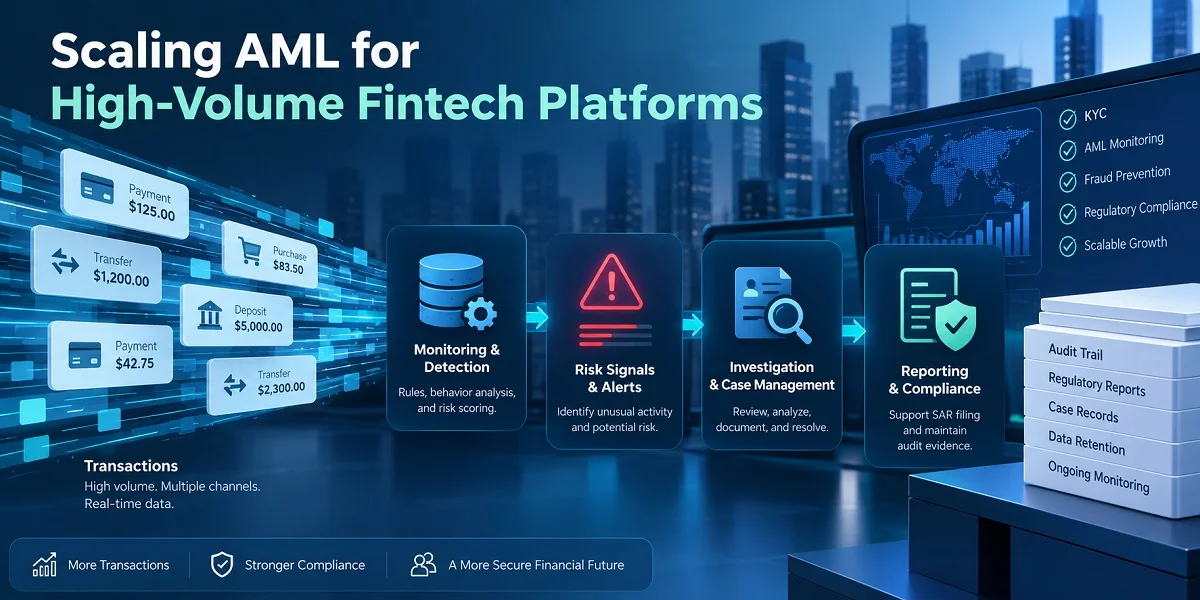
The next layer handles monitoring. Rules can evaluate transaction values, frequency, account behavior, customer risk factors, counterparties, and patterns across a sequence of events. The system can then create a risk signal when activity meets a defined condition.
This layer needs separation from the investigation workflow. Detection identifies activity that needs attention. Investigation determines what that activity means.
An alert should give an analyst enough context to begin that investigation. The case view can contain the triggering transaction, customer information, related activity, previous alerts, and the rule that produced the signal. Without this context, analysts have to collect information from separate systems before reviewing the case.
Case management becomes another part of the architecture as volume grows. Each investigation needs an owner, status, evidence, notes, decisions, and history. Access controls should determine who can view or change case information. The system should preserve records that show how a decision was reached.
Suspicious Activity Report, or SAR, workflows can follow the investigation process for organizations subject to those reporting requirements. An alert does not mean a SAR must be filed. The architecture should support the compliance team’s decision process and preserve the information required for reporting when a case reaches that stage.
The result is a connected sequence. Transaction events enter the monitoring layer. Rules produce risk signals. Signals create alerts. Alerts enter case workflows. Investigations produce decisions and supporting evidence.
This structure reduces dependence on spreadsheets and disconnected tools without removing human judgment from compliance decisions.
Where Automation Helps and Where Human Review Still Matters
Automation has the most value when it handles repeatable work. A system can collect transaction records, apply monitoring rules, group related events, route alerts, enforce access permissions, and maintain case histories.
Human review remains important when a decision depends on context. A transaction can appear unusual because a customer’s behavior changed for a valid reason. A rule can identify a pattern, but an analyst may need account history and supporting information to determine whether the activity warrants escalation.
The architecture should reflect this division of work. Software handles transaction volume and information movement. Analysts handle investigation and judgment. This prevents the compliance team from spending its capacity on data collection while preserving human review for decisions that carry regulatory consequences.
The same principle applies when teams introduce machine learning or AI into monitoring. Models can support risk detection or case analysis, but teams still need controls for data access, model outputs, testing, documentation, and review. Adding AI does not remove the need for a defined compliance process.
Final Thoughts
Manual AML processes can support a fintech platform while transaction volume and operational complexity remain limited. Growth changes that equation. More payments create more data to assess, more patterns to examine, more alerts to investigate, and more evidence to preserve.
A scalable AML architecture needs reliable transaction data, defined monitoring rules, useful alerts, investigation workflows, access controls, case histories, and reporting support. Automation can handle repeatable processing, while compliance teams retain responsibility for investigations and decisions that require context.
The point is not to replace manual AML work with automation at every stage. It is to decide which work belongs in software and which work requires human judgment. Building that distinction into the platform gives fintech teams a compliance foundation that can support higher transaction volume without turning the review process into the constraint on growth.