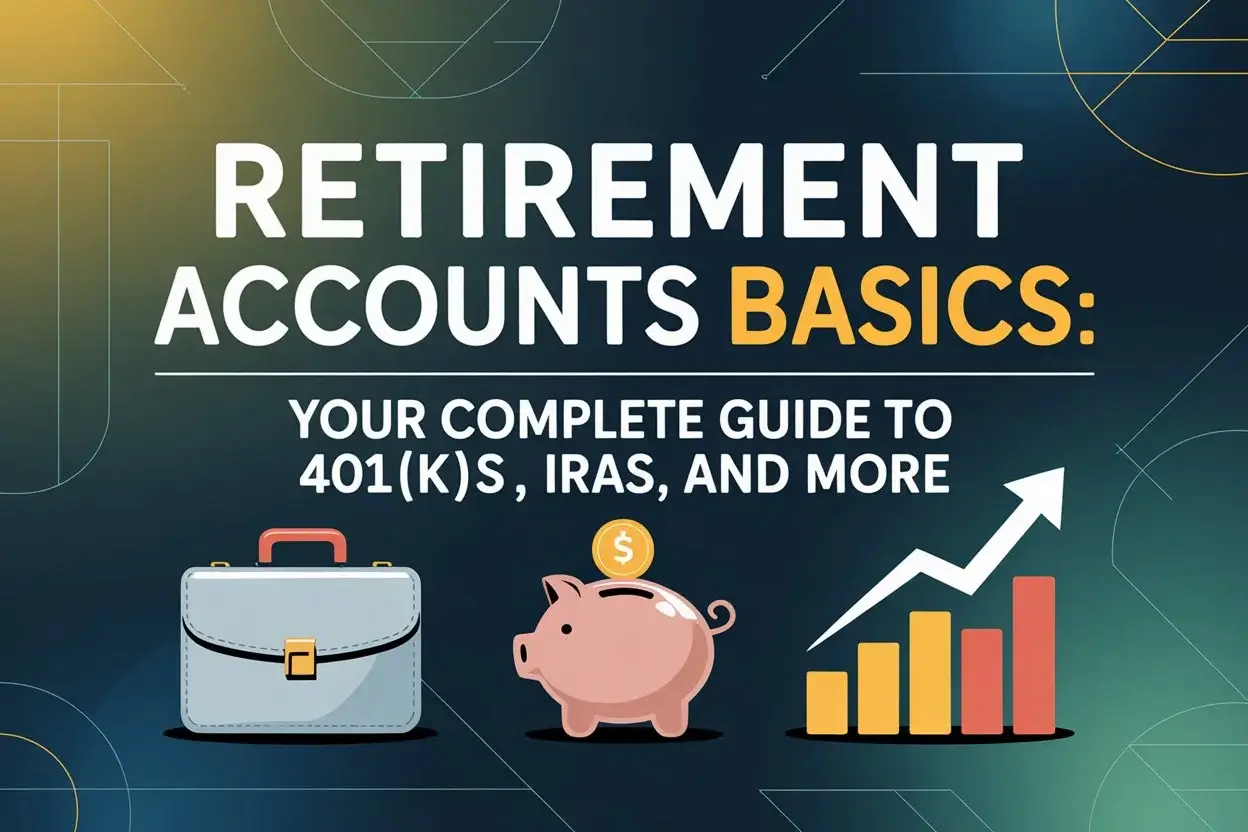
Retirement Accounts Basics: Your Complete Guide to 401(k)s, IRAs, and More
Let me guess: you’ve heard terms like “401(k)” and “IRA” thrown around, but you’re not entirely sure what they actually are or why they matter.
Maybe you’ve been nodding along in conversations about retirement accounts, pretending you understand, while internally thinking “I really should know this stuff by now.”
You’re not alone.
Most people are completely confused by retirement accounts. The names are weird (what even is a 401(k)?). The rules seem complicated. The choices feel overwhelming.
So they just… pick whatever their employer defaults them into and hope for the best.
Here’s the thing: understanding retirement accounts is one of the highest-value things you can learn about personal finance.
We’re not talking about a few hundred dollars here. Making smart choices about retirement accounts can literally mean hundreds of thousands of dollars difference by the time you retire.
And it’s not actually that complicated once someone explains it in plain English.
This guide will walk you through everything you need to know about retirement accounts: what they are, how they work, the different types, which ones you should use, and how to maximize their benefits.
No jargon. No confusing technical stuff. Just clear, practical information you can actually use.
Let’s break it down.
What Is a Retirement Account (And Why Should You Care)?
A retirement account is simply a special type of investment account with tax benefits designed to help you save for retirement.
Think of it like a regular investment account, but with two huge advantages:
1. Tax Benefits
Retirement accounts give you tax breaks that regular investment accounts don’t:
- Tax deduction now (Traditional accounts — pay less tax today)
- Tax-free growth forever (Roth accounts — never pay tax on earnings)
- Tax-free withdrawals (depending on account type)
These tax benefits can save you tens of thousands or even hundreds of thousands of dollars over your lifetime.
2. Extra Incentives
Many retirement accounts come with bonuses:
- Employer matching (literally free money)
- Higher contribution limits (save more than regular accounts)
- Creditor protection (money is protected in bankruptcy)
- Forced discipline (harder to withdraw = less temptation to spend)
Bottom line: Retirement accounts are the single best tool for building long-term wealth, and the government literally gives you tax breaks to encourage using them.
Not using them is like saying no to free money.
The Two Main Categories: Tax-Deferred vs. Tax-Free
Before we dive into specific account types, you need to understand the fundamental difference:
Tax-Deferred Accounts (Traditional)
How it works:
- You contribute pre-tax money (reduces your taxable income today)
- Money grows tax-deferred (no taxes while it’s growing)
- You pay regular income tax when you withdraw in retirement
Example:
You make $60,000 and contribute $5,000 to Traditional 401(k).
Taxable income = $55,000 (you save on taxes now)
Money grows for 30 years.
You retire and withdraw $40,000/year → you pay regular income tax on withdrawals
Best for:
- People in high tax brackets now who expect lower brackets in retirement
- Anyone who needs the current tax deduction
Tax-Free Accounts (Roth)
How it works:
- You contribute after-tax money (no deduction today)
- Money grows tax-free (no taxes while it’s growing)
- You pay zero taxes on withdrawals in retirement
Example:
You make $60,000 and contribute $5,000 to Roth IRA.
Taxable income = $60,000 (no tax benefit now)
Money grows for 30 years.
You retire and withdraw $40,000/year → completely tax-free
Best for:
- Younger people in lower tax brackets (expect to earn more later)
- Anyone who wants tax-free retirement income
- People expecting higher taxes in retirement
Which Is Better?
It depends on your situation:
Choose Traditional if:
- You’re in a high tax bracket now (save on taxes immediately)
- You expect to be in a lower bracket in retirement
- You need the tax deduction to reduce current tax bill
Choose Roth if:
- You’re young and in a lower tax bracket
- You expect higher income (and higher taxes) later
- You want tax diversification in retirement
- You value flexibility (Roth has fewer restrictions)
Honest answer: Most people should use both over their lifetime. More on that later.
The Main Retirement Account Types (Explained Simply)
Now let’s break down each type of retirement account you’ll encounter:
1. 401(k) — The Employer-Sponsored Workhorse
What it is:
A retirement account offered by your employer (named after a section of the tax code, because… government).
How it works:
- Money comes straight from your paycheck before you see it
- You choose how much to contribute (percentage or dollar amount)
- Employer might match part of your contribution (FREE MONEY!)
- You pick investments from a menu of options
- Money grows tax-deferred or tax-free (depending on Traditional vs. Roth)
Contribution limits (2024):
- Under 50: $23,000/year
- 50+: $30,500/year (includes $7,500 catch-up)
The employer match:
This is the most important part.
Example:
Employer matches 50% of your contributions up to 6% of salary.
Your salary: $60,000
You contribute 6%: $3,600
Employer adds 50%: $1,800 FREE MONEY
That’s an instant 50% return. You literally cannot beat that anywhere.
Traditional 401(k) vs. Roth 401(k):
Many employers now offer both:
- Traditional 401(k): Pre-tax contributions, taxed at withdrawal
- Roth 401(k): After-tax contributions, tax-free withdrawals
You can split contributions between both if you want.
Pros: ✅ Very high contribution limits
✅ Employer match (if offered)
✅ Automatic payroll deductions (easy to stick with)
✅ Reduces current taxable income (Traditional)
Cons: ❌ Limited investment options (only what employer offers)
❌ May have high fees
❌ Required minimum distributions at 73
❌ Penalties for early withdrawal before 59½
Who should use it:
EVERYONE with access to one, at minimum to get the full employer match.
2. 403(b) — The Non-Profit Version of 401(k)
What it is:
Basically a 401(k) but for:
- Teachers and school employees
- Non-profit organizations
- Religious groups
- Government workers (some)
How it’s different from 401(k):
Honestly? Not much. Same contribution limits, same tax treatment, often same investment options.
Sometimes has slightly lower fees or different investment choices (annuities vs. mutual funds).
Everything else is basically the same as a 401(k).
3. Traditional IRA — The Individual Retirement Account
What it is:
A retirement account you open yourself (not through an employer).
How it works:
- You open it at a brokerage (Vanguard, Fidelity, Schwab, etc.)
- You contribute money directly (not from paycheck)
- You get a tax deduction on contributions
- Money grows tax-deferred
- You pay taxes when you withdraw in retirement
Contribution limits (2024):
- Under 50: $7,000/year
- 50+: $8,000/year (includes $1,000 catch-up)
Income limits for deductibility:
If you (or your spouse) have a 401(k) at work, the deduction might be reduced or eliminated at higher incomes:
- Single: Phases out $77,000-$87,000
- Married: Phases out $123,000-$143,000
If you don’t have a workplace plan, you can deduct regardless of income.
Pros: ✅ Open to anyone with earned income
✅ Tax deduction (if eligible)
✅ Total control over investments
✅ Usually lower fees than 401(k)s
✅ Can shop around for best provider
Cons: ❌ Lower contribution limits than 401(k)
❌ No employer match
❌ Income limits for deductibility
❌ Required minimum distributions at 73
❌ Penalties for early withdrawal before 59½
Who should use it:
- Anyone who’s maxed out their 401(k) match
- Self-employed people
- Anyone wanting more investment control
- People looking for additional tax-deferred space
4. Roth IRA — The Tax-Free Growth Champion
What it is:
Like a Traditional IRA, but with after-tax contributions and tax-free withdrawals.
How it works:
- You contribute after-tax money (no deduction now)
- Money grows completely tax-free
- Withdrawals in retirement are 100% tax-free
- Can withdraw contributions anytime penalty-free (not earnings)
- No required minimum distributions (can let it grow forever)
Contribution limits (2024):
Same as Traditional IRA:
- Under 50: $7,000/year
- 50+: $8,000/year
Income limits:
Roth IRAs phase out at higher incomes:
- Single: $146,000-$161,000
- Married: $230,000-$240,000
Above these limits, you can’t contribute directly (but see “Backdoor Roth” later).
Pros: ✅ Tax-free growth and withdrawals forever
✅ No required minimum distributions
✅ Can withdraw contributions anytime
✅ Estate planning benefits
✅ Total investment control
Cons: ❌ No upfront tax deduction
❌ Lower contribution limits
❌ Income limits restrict access
❌ No employer match
Who should use it:
- Young people (decades of tax-free growth)
- Anyone eligible (seriously, this account is amazing)
- People wanting tax diversification
- Anyone who thinks taxes will be higher in the future
My opinion: The Roth IRA is the single best retirement account for most people under 40.
5. SEP IRA — For Self-Employed People
What it is:
A retirement account for self-employed individuals and small business owners.
How it works:
- You contribute as the “employer” (yourself)
- Contributions are tax-deductible
- Money grows tax-deferred
- Similar to Traditional IRA in tax treatment
Contribution limits (2024):
Up to 25% of compensation or $69,000 (whichever is less)
This is WAY higher than regular IRAs.
Example:
Self-employment income: $100,000
You can contribute: $25,000 (25%)
Compare that to $7,000 IRA limit!
Pros: ✅ Very high contribution limits
✅ Easy to set up and maintain
✅ Tax-deductible contributions
✅ Flexible (can vary contributions year to year)
Cons: ❌ Must contribute same percentage for employees (if you have any)
❌ No Roth option
❌ No catch-up contributions
❌ Required minimum distributions at 73
Who should use it:
- Freelancers
- Contractors
- Small business owners without employees
- Side hustlers with self-employment income
6. Solo 401(k) — The Self-Employed Power Account
What it is:
A 401(k) for self-employed people with no employees (except spouse).
How it works:
You contribute in two ways:
- As employee: Up to $23,000 (same as regular 401(k))
- As employer: Up to 25% of compensation
Total limit: $69,000 ($76,500 if 50+)
Example:
Self-employment income: $100,000
- Employee contribution: $23,000
- Employer contribution: $20,000
- Total: $43,000
WAY more than a SEP IRA or regular IRA.
Pros: ✅ Highest contribution limits available
✅ Roth option available
✅ Can make loans to yourself
✅ Catch-up contributions at 50+
Cons: ❌ More paperwork than SEP
❌ Can’t have employees (except spouse)
❌ Must file additional form if over $250k in assets
Who should use it:
- Self-employed people wanting to save aggressively
- High-earning freelancers
- Anyone who wants to max out retirement savings
If you’re self-employed and have good income, Solo 401(k) > SEP IRA in most cases.
7. HSA — The Secret Retirement Weapon
What it is:
Technically a Health Savings Account, but it’s secretly the best retirement account that exists.
Why it’s amazing:
Triple tax advantage (the only account with this):
- Tax deduction on contributions
- Tax-free growth
- Tax-free withdrawals (for medical expenses)
After age 65: Can withdraw for anything, just pay regular taxes (like Traditional IRA)
How it works:
- Must have high-deductible health plan (HDHP)
- Contribute pre-tax money
- Invest it (don’t just leave in cash!)
- Use for medical expenses tax-free
- Or save it for retirement healthcare costs
Contribution limits (2024):
- Individual: $4,150
- Family: $8,300
- 55+: Extra $1,000 catch-up
The strategy:
Max it out, invest it, pay current medical expenses out of pocket, let HSA grow tax-free for 30 years, use it for healthcare in retirement.
Healthcare in retirement is expensive ($300,000+ for average couple). HSA is perfect for this.
Pros: ✅ Triple tax advantage (unique!)
✅ No “use it or lose it” (rolls over forever)
✅ Can invest like an IRA
✅ Flexible after 65
✅ No required minimum distributions
Cons: ❌ Must have HDHP (high-deductible health plan)
❌ Can’t contribute once on Medicare
❌ Penalties if used for non-medical before 65
❌ Lower contribution limits
Who should use it:
Everyone who has access. Seriously. This account is ridiculously powerful.
Comparing Retirement Accounts Side-by-Side
| Account | Contribution Limit | Tax Treatment | Employer Match? | Who Can Use |
|---|---|---|---|---|
| 401(k) | $23,000 ($30,500 if 50+) | Traditional or Roth | Often Yes | Employees |
| Traditional IRA | $7,000 ($8,000 if 50+) | Tax-deferred | No | Anyone w/ income |
| Roth IRA | $7,000 ($8,000 if 50+) | Tax-free | No | Income limits apply |
| SEP IRA | Up to $69,000 | Tax-deferred | No | Self-employed |
| Solo 401(k) | Up to $69,000 ($76,500 if 50+) | Traditional or Roth | You match yourself | Self-employed (no employees) |
| HSA | $4,150 / $8,300 | Triple tax-free | No | HDHP required |
The Optimal Retirement Account Strategy (Step-by-Step)
Here’s the order most people should contribute:
Step 1: 401(k) Up to Employer Match
Contribute enough to get the full employer match.
This is free money with an instant 50-100% return. Nothing beats this.
Example:
Employer matches 50% up to 6% of salary.
You contribute: 6% of salary
Stop here for now. Move to Step 2.
Step 2: Max Out HSA (If Eligible)
If you have a high-deductible health plan, max out your HSA.
Triple tax advantage beats everything else.
Contribute: $4,150 (individual) or $8,300 (family)
Step 3: Max Out Roth IRA
Max out Roth IRA if you’re eligible.
Tax-free growth for decades is powerful, especially if you’re young.
Contribute: $7,000 ($8,000 if 50+)
Step 4: Max Out 401(k)
Go back and max out your 401(k).
Contribute: Up to $23,000 total ($30,500 if 50+)
Step 5: Taxable Brokerage Account
If you’ve maxed everything above, invest in a regular taxable account.
Still great for long-term growth, just without the tax advantages.
This order maximizes:
- Free money (employer match)
- Tax advantages (HSA, Roth)
- High contribution limits (401k)
Example:
Salary: $80,000
- 401(k) match (6%): $4,800
- HSA max: $4,150
- Roth IRA max: $7,000
- 401(k) additional: $18,200
- Total: $34,150 (43% savings rate!)
Advanced Strategies (Once You Know the Basics)
The Backdoor Roth IRA
Problem: You earn too much to contribute to Roth IRA directly.
Solution:
- Contribute to Traditional IRA (no income limits for this)
- Immediately convert to Roth IRA
- Pay taxes on conversion (usually minimal if done immediately)
- Now you have Roth IRA despite high income
This is completely legal and IRS-approved.
Best for: High earners above Roth IRA income limits
The Mega Backdoor Roth
Problem: You want to save more than $23,000 in your 401(k).
Solution:
If your 401(k) allows:
- Make after-tax (not Roth) contributions beyond $23,000
- Immediately convert to Roth 401(k) or roll to Roth IRA
- Can contribute up to $69,000 total annually
This is complex and not all plans allow it, but it’s incredibly powerful.
Best for: High earners who’ve maxed everything else
Roth Conversion Ladder
Problem: You retire early and need to access retirement money before 59½.
Solution:
- Convert Traditional IRA to Roth IRA
- Wait 5 years
- Withdraw converted amount penalty-free
Do this annually to create a “ladder” of accessible money.
Best for: Early retirees
Tax Bracket Arbitrage
Strategy:
- Contribute to Traditional 401(k) during high-earning years (save at high tax rate)
- Withdraw in retirement during low-income years (pay at low tax rate)
Or reverse:
- Contribute to Roth during low-income years (pay tax at low rate)
- Withdraw in retirement during high-income years (no tax!)
Best for: Strategic tax planners
Common Retirement Account Mistakes (And How to Avoid Them)
Mistake 1: Not Contributing Enough for Employer Match
Fix: At minimum, contribute enough to get full match. Leaving this on the table is leaving free money on the table.
Mistake 2: Not Opening Any Retirement Accounts
Fix: Open a Roth IRA today. It takes 20 minutes. Start with $50/month if that’s all you can do. While you’re setting it up, make sure you’re protecting it properly too — use a password generator to create a strong, unique password for each financial account, since reusing passwords across brokerage and retirement platforms is one of the easiest ways to get your savings compromised.
Mistake 3: Keeping Everything in Cash
Fix: Retirement accounts should be INVESTED. Sitting in cash means no growth. Choose target-date funds if overwhelmed.
Mistake 4: Paying High Fees
Fix: Choose low-cost index funds. Fees under 0.20%. Every 1% in fees can cost you $100,000+ over 30 years.
Mistake 5: Panicking and Selling During Crashes
Fix: Don’t look at accounts during crashes. Stay invested. Retirement accounts are 20-40 year investments.
Mistake 6: Early Withdrawals
Fix: NEVER withdraw early except absolute emergency. Penalties, taxes, and lost growth destroy your retirement.
Mistake 7: Not Diversifying Between Traditional and Roth
Fix: Use both over your lifetime. Gives you tax flexibility in retirement.
Mistake 8: Forgetting to Update Beneficiaries
Fix: Review beneficiaries annually. After marriages, divorces, births, deaths.
Frequently Asked Questions
Q: Can I have multiple retirement accounts?
Yes! You can have 401(k) AND IRA AND HSA all at once. The limits are per account type.
Q: What happens if I change jobs?
You can:
- Roll old 401(k) to new employer’s 401(k)
- Roll to IRA (usually better — more control, lower fees)
- Leave it at old employer (not recommended)
- Cash out (NEVER do this — penalties and taxes)
Q: When can I withdraw without penalty?
Generally age 59½ for most accounts. Earlier with some exceptions (first home, education, disability, etc.).
Q: What if I need the money before retirement?
Build emergency fund separately. Retirement money should be untouchable except true emergencies.
Roth IRA lets you withdraw contributions (not earnings) anytime penalty-free.
Q: Should I do Traditional or Roth?
General rule: Roth if you’re young or in low tax bracket. Traditional if high earner in peak earning years. Mix of both is ideal.
Q: How do I actually invest the money?
Most people should choose:
- Target-date fund (automatically adjusts over time)
- Or simple three-fund portfolio (total stock, total international, total bond)
Don’t overcomplicate it.
Q: What if I’m self-employed?
SEP IRA or Solo 401(k). Solo 401(k) is usually better if you have good income.
Q: Can I contribute to both 401(k) and IRA?
Yes! They have separate limits. You can max both.
Final Thoughts: Retirement Accounts Are Your Wealth-Building Foundation
Here’s the bottom line:
Retirement accounts are the single most powerful wealth-building tool available to regular people.
The tax advantages are enormous. The compound growth is life-changing. The employer matches are literally free money.
Not using them is financial self-sabotage.
You don’t need to understand every detail perfectly. You don’t need to optimize every decision. You don’t need to be a financial expert.
You just need to:
✅ Start contributing (even small amounts)
✅ Get the employer match
✅ Choose low-cost investments
✅ Stay consistent
✅ Don’t touch it until retirement
That’s it. That’s the whole game.
The complicated stuff? You can learn it over time. The advanced strategies? They’re bonuses, not requirements.
Just start.
Open that Roth IRA this week. Increase your 401(k) contribution by 1%. Max out your HSA.
Small actions today compound into massive results tomorrow.
Your 65-year-old self will thank you.
And honestly? They’ll probably wish you’d started even sooner.
So don’t wait. Start now.