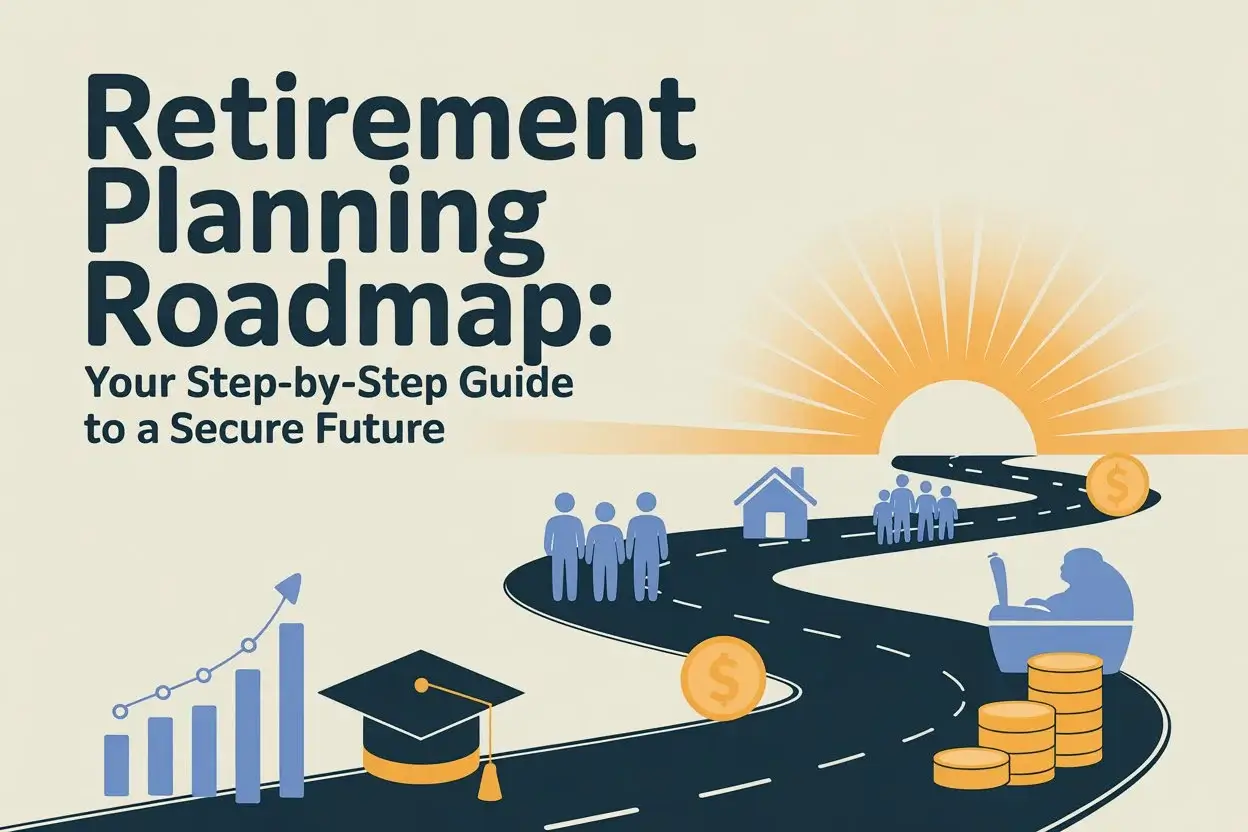
Retirement Planning Roadmap: Your Step-by-Step Guide to a Secure Future
Let me guess: you know you should be planning for retirement, but you have no idea where to actually start.
You’re not alone.
Most people feel completely overwhelmed by retirement planning. There are so many questions, so many options, so many what-ifs:
How much do I need? When should I start? Which accounts should I use? Should I do a Roth or Traditional? What about Social Security? How do I invest? What if I’m already behind?
It’s paralyzing. So most people just… don’t do it. They keep saying “I’ll start next year” until suddenly they’re 55 and realize they’re way behind.
Here’s the good news: retirement planning doesn’t have to be complicated.
You don’t need to be a financial genius. You don’t need fancy software or an expensive advisor (though both can help). You just need a clear roadmap — a step-by-step plan that takes you from wherever you are now to a secure retirement.
That’s exactly what this guide is.
Consider this your complete retirement planning roadmap: organized by age and life stage, with specific action steps for each phase of your journey.
Whether you’re 25 or 55, whether you’re crushing it financially or just getting started, there’s a path forward.
Let’s map it out.
What Is a Retirement Planning Roadmap?
A retirement planning roadmap is simply a strategic plan that guides you from where you are today to where you want to be in retirement.
Think of it like planning a cross-country road trip:
- Destination: Comfortable retirement (your goal)
- Starting point: Your current financial situation
- Route: The steps you’ll take to get there
- Milestones: Age-based checkpoints to keep you on track
- Course corrections: Adjustments when life happens
The roadmap breaks down an overwhelming 30-40 year journey into manageable phases, each with specific goals and action steps.
No matter where you are right now, you can get on the path.
The 5 Phases of Retirement Planning
Most people’s retirement journey follows five distinct phases:
Phase 1: Foundation (20s – Early 30s)
Focus: Build habits, start saving, eliminate debt
Phase 2: Acceleration (Mid 30s – 40s)
Focus: Maximize earnings, aggressive saving, grow investments
Phase 3: Peak Accumulation (50s – Early 60s)
Focus: Final push, catch-up contributions, serious wealth building
Phase 4: Transition (Late 60s – Early 70s)
Focus: Shift from accumulation to preservation, begin withdrawals
Phase 5: Distribution (70s+)
Focus: Sustainable withdrawals, estate planning, legacy
Let’s break down exactly what you should be doing in each phase.
Phase 1: Foundation Building (Ages 20-35)
Your Mission: Build the foundation that makes everything else possible.
This phase isn’t about accumulating massive wealth — it’s about establishing habits, systems, and knowledge that will compound for decades.
Key Priorities:
1. Start Contributing to Retirement (Even If It’s Tiny)
Action steps:
✅ Enroll in your employer’s 401(k) or 403(b) — even if it’s just 3-5% to start
✅ Contribute enough to get the full employer match (this is free money!)
✅ Set up automatic contributions so you never “forget” to save
✅ Open a Roth IRA if eligible (you can start with $50-100/month)
Target: Save at least 10-15% of your income for retirement
Why this matters:
Starting at 25 vs. 35 can literally mean hundreds of thousands of dollars difference by retirement due to compound growth.
Example:
Starting at 25:
$300/month × 40 years at 8% return = ~$1,036,000
Starting at 35:
$300/month × 30 years at 8% return = ~$447,000
That extra 10 years? Worth nearly $600,000.
Time is your biggest advantage. Use it.
2. Eliminate High-Interest Debt
Action steps:
✅ Pay off credit cards aggressively (interest rates of 18-25% destroy wealth)
✅ Avoid new consumer debt (cars, gadgets, etc.)
✅ Student loans: Make required payments, but don’t obsess over low-interest debt
✅ Build debt payoff into your budget systematically
Why this matters:
Paying 20% interest on credit cards while trying to earn 8% in investments is backwards. Kill the high-interest debt first.
3. Build an Emergency Fund
Action steps:
✅ Start with $1,000 as a starter emergency fund
✅ Build to 3-6 months of expenses over time
✅ Keep it in a high-yield savings account (easy access, no risk)
✅ Don’t invest emergency money in stocks
Why this matters:
Without an emergency fund, you’ll raid your retirement accounts when life happens — destroying your long-term progress.
4. Learn the Basics of Investing
Action steps:
✅ Understand stocks vs. bonds (basic asset classes)
✅ Learn about index funds (your best friend for retirement)
✅ Read one good investing book (I suggest “The Simple Path to Wealth”)
✅ Understand fees (expense ratios, management fees)
✅ Avoid individual stock picking (index funds are safer and easier)
Why this matters:
Financial literacy pays dividends (literally) for life. An hour of learning can be worth thousands of dollars.
5. Focus on Career Growth
Action steps:
✅ Invest in skills that increase your earning potential
✅ Don’t job hop just for 5% raises — build expertise
✅ Network intentionally in your industry
✅ Negotiate salary at job changes (biggest opportunity for income growth)
✅ Side hustles can accelerate savings (but don’t burn out)
Why this matters:
Your income is your most powerful wealth-building tool in your 20s and 30s. Growing from $50k to $80k income matters more than perfect investment allocation at this stage.
6. Understand Your Benefits
Action steps:
✅ Read your 401(k) plan documents (know your options)
✅ Understand your employer match (don’t leave money on table)
✅ Review health insurance options (HSA if eligible — powerful retirement tool)
✅ Know about pension if you have one (rare but valuable)
Phase 1 Milestones:
By age 30-35, aim to have:
✅ 1-2× your annual salary saved for retirement
✅ No high-interest debt
✅ 3-6 months emergency fund
✅ Consistent 10-15% savings rate
✅ Basic investing knowledge
✅ Automatic contributions set up
Real Talk:
If you’re not hitting these milestones, don’t panic. You’re not behind forever. You can catch up. But this is your signal to get serious now.
Phase 2: Acceleration (Ages 35-50)
Your Mission: Maximize your prime earning years and aggressively build wealth.
This is typically your highest-earning phase before retirement. You’re established in your career, (hopefully) past entry-level salaries, and have 15-30 years of compound growth ahead.
This is your power decade for retirement savings.
Key Priorities:
1. Maximize Tax-Advantaged Contributions
Action steps:
✅ Max out your 401(k) if possible ($23,000/year in 2024, $30,500 if 50+)
✅ Max out Roth IRA ($7,000/year, $8,000 if 50+)
✅ Max out HSA if eligible ($4,150 individual, $8,300 family in 2024)
✅ Consider mega backdoor Roth if your plan allows (advanced move)
Target: Save 15-25% of your income for retirement
Why this matters:
Tax-advantaged space is limited. Use it or lose it each year. Maxing these out creates massive tax savings over decades.
Example:
Maxing 401(k) + Roth IRA = $30,000/year saved
Over 15 years at 8% return = ~$867,000
And that’s just from these two accounts.
2. Aggressively Grow Your Income
Action steps:
✅ Push for promotions and increased responsibility
✅ Switch companies strategically (often biggest salary jumps)
✅ Develop high-value skills (management, technical expertise, sales)
✅ Build side income if you have capacity (but don’t burn out)
✅ Negotiate every job offer (never accept first offer)
Why this matters:
Going from $75k to $125k income in your 40s can add $500,000+ to your retirement savings by 65.
Income growth is a lever that amplifies everything else.
3. Avoid Lifestyle Inflation
Action steps:
✅ Save 50% of all raises (enjoy 50%, save 50%)
✅ Don’t upgrade house/car just because you can afford it
✅ Question major purchases (do you need it or want it?)
✅ Keep “luxury creep” in check (small upgrades add up)
✅ Focus on experiences over things (research shows they make you happier anyway)
Why this matters:
Most people’s spending grows exactly as fast as their income. They make $100k but still live paycheck to paycheck.
Breaking this cycle is the difference between retiring at 50 vs. 70.
4. Optimize Your Investment Strategy
Action steps:
✅ Review your asset allocation (should be aggressive at this age)
✅ Rebalance annually (maintain target allocation)
✅ Minimize fees (switch to low-cost index funds if needed)
✅ Diversify globally (add international stocks)
✅ Don’t panic sell during crashes (stay the course)
✅ Consider tax-loss harvesting in taxable accounts
Typical allocation at this age:
- 70-80% stocks (U.S. and international)
- 20-30% bonds
- Adjust based on risk tolerance
Why this matters:
You have 15-30 years until retirement. You can handle volatility. Being too conservative now costs hundreds of thousands in lost growth.
5. Protect Your Family
Action steps:
✅ Get term life insurance (if you have dependents)
✅ Update beneficiaries on all accounts
✅ Create/update will
✅ Consider disability insurance (protects your income)
✅ Review health insurance (adequate coverage)
Why this matters:
Your income is your biggest asset. Protect it. Also, if something happens to you, your family shouldn’t be financially devastated.
6. Start Planning Specifics
Action steps:
✅ Calculate your retirement number (use 25× annual expenses rule)
✅ Run retirement calculator projections
✅ Estimate Social Security benefits (visit ssa.gov)
✅ Think about ideal retirement age (60? 65? 55?)
✅ Model different scenarios (early retirement, traditional, etc.)
Phase 2 Milestones:
By age 45-50, aim to have:
✅ 4-6× your annual salary saved for retirement
✅ Maxing at least one tax-advantaged account
✅ 15-25% savings rate consistently
✅ Diversified investment portfolio
✅ Clear retirement vision (age, lifestyle, number)
✅ Adequate insurance protection
Real Talk:
If you’re 40 and behind, this is your wake-up call. You have 20-25 years to fix it, but you need to act NOW. Increase savings rate to 30%+. Make hard choices. It’s doable but requires urgency.
Phase 3: Peak Accumulation (Ages 50-65)
Your Mission: Final push to maximize retirement savings before you stop working.
This is crunch time. Retirement is getting close. Your earning power should be at or near its peak. Kids are (hopefully) financially independent.
Time to go all-in on retirement savings.
Key Priorities:
1. Utilize Catch-Up Contributions
Action steps:
✅ At age 50, increase 401(k) contributions (+$7,500 catch-up = $30,500 total)
✅ Increase IRA contributions (+$1,000 catch-up = $8,000 total)
✅ Max out HSA if eligible
✅ Consider spousal contributions if one partner doesn’t work
Why this matters:
These extra catch-up amounts can add $150,000-$200,000 to your retirement savings over 15 years.
Example:
Max catch-up in 401(k) for 15 years:
$7,500 × 15 years at 8% return = ~$204,000 extra
That’s life-changing money.
2. Eliminate Remaining Debt
Action steps:
✅ Pay off mortgage if possible (or create plan to pay it off by retirement)
✅ Zero out all consumer debt (cars, credit cards, loans)
✅ Don’t take on new debt unless absolutely necessary
✅ Consider downsizing if house is too big/expensive
Why this matters:
Retiring debt-free means you need far less in retirement savings. Every $1,000/month in debt payments eliminated = $300,000 less needed in your retirement portfolio (at 4% withdrawal rate).
3. Get Serious About Your Number
Action steps:
✅ Calculate exact retirement expenses (track current spending)
✅ Estimate healthcare costs before Medicare
✅ Factor in travel, hobbies (what will retirement actually cost?)
✅ Calculate your FIRE number (annual expenses × 25)
✅ Compare to current savings (are you on track?)
✅ Adjust plan if needed (save more, work longer, spend less)
Target: Have 6-10× annual salary saved by age 60
4. Optimize Tax Strategy
Action steps:
✅ Consider Roth conversions (especially in low-income years)
✅ Harvest tax losses in taxable accounts
✅ Plan withdrawal strategy (which accounts to tap when)
✅ Understand RMD rules (Required Minimum Distributions)
✅ Consult tax professional (worth the money at this stage)
Why this matters:
Smart tax planning can save you $50,000-$200,000 over your retirement. That’s not an exaggeration.
5. Shift Toward Preservation
Action steps:
✅ Gradually reduce stock allocation (shift from 80% to 60-70% stocks)
✅ Increase bond allocation (add stability)
✅ Build cash reserves (1-2 years of expenses)
✅ Consider bucket strategy (separate short/medium/long-term money)
✅ Reduce investment risk as you approach retirement date
As retirement approaches, diversification can extend beyond traditional stocks and bonds. Some investors also explore insurance-linked securities, including life insurance-based alternative assets such as life settlements, which can offer exposure to longevity-related risks and returns that are less directly tied to conventional market movements.
Why this matters:
The sequence of returns risk — a market crash right when you retire — can destroy your retirement plan. Protect what you’ve built.
6. Plan Social Security Strategy
Action steps:
✅ Create account at ssa.gov and review your earnings record
✅ Estimate benefits at different claiming ages (62, 67, 70)
✅ Model spousal strategies if married
✅ Understand survivor benefits
✅ Decide tentative claiming age (can adjust later)
Why this matters:
Claiming at 62 vs. 70 can mean a 76% difference in monthly benefits. That’s potentially $500,000+ difference over your lifetime.
This decision matters enormously.
7. Prepare for Healthcare Transition
Action steps:
✅ Understand Medicare (Parts A, B, C, D)
✅ Plan for gap years (if retiring before 65)
✅ Research ACA marketplace options
✅ Max HSA contributions (triple tax advantage)
✅ Budget $10,000-$15,000/year for healthcare in early retirement
Why this matters:
Healthcare is often the #1 unknown that derails early retirement. Plan for it now.
8. Do a Retirement Test Run
Action steps:
✅ Live on your retirement budget for 3-6 months
✅ Track every dollar (can you actually live on this?)
✅ Identify budget leaks before you retire
✅ Adjust expectations if needed
✅ Practice the lifestyle (what will you actually do all day?)
Why this matters:
Better to discover you need $10,000 more per year before you retire than after.
Phase 3 Milestones:
By age 60-65, aim to have:
✅ 8-10× your annual salary saved for retirement
✅ All debt eliminated (including mortgage)
✅ Specific retirement date chosen
✅ Healthcare plan for pre-Medicare years
✅ Social Security strategy decided
✅ Investment allocation shifted toward preservation
✅ Withdrawal strategy mapped out
Real Talk:
If you’re 55 and way behind, it’s not hopeless, but you need to make hard choices:
- Save 40-50% of income (extreme, but possible)
- Work until 70 (delaying retirement 5 years helps enormously)
- Drastically reduce retirement lifestyle expectations
- Consider geographic arbitrage (move somewhere cheaper)
- Plan on part-time work in retirement
It’s not ideal, but it’s better than retiring into poverty.
Phase 4: Transition to Retirement (Ages 65-70)
Your Mission: Successfully transition from accumulation to distribution mode.
This is where everything changes. You stop adding money and start living off it.
This transition is psychologically and financially challenging.
Key Priorities:
1. Finalize Retirement Date
Action steps:
✅ Choose your last day of work (specific date)
✅ Notify employer (consider working part-time if offered)
✅ Plan transition period (phased retirement if possible)
✅ Coordinate with spouse if married (retire together or staggered?)
2. Claim Social Security Strategically
Action steps:
✅ Review your claiming strategy one more time
✅ Consider delaying to 70 if you can afford it (8% annual increase)
✅ Coordinate with spouse (higher earner usually delays)
✅ File online at ssa.gov or visit local office
✅ Set up direct deposit
Remember: Every year you delay = ~8% permanent increase in benefits
3. Enroll in Medicare
Action steps:
✅ Sign up 3 months before turning 65 (avoid penalties)
✅ Choose Medicare Part B (usually)
✅ Decide on Part D (prescription drug coverage)
✅ Choose Medigap or Medicare Advantage (supplement coverage)
✅ Coordinate with HSA if you have one (can’t contribute after Medicare)
4. Implement Withdrawal Strategy
Action steps:
✅ Decide on withdrawal rate (4%, 3.5%, dynamic, etc.)
✅ Choose withdrawal order (which accounts first)
✅ Set up automatic transfers (monthly income)
✅ Build 1-2 year cash buffer (don’t sell stocks in crashes)
✅ Plan for taxes on withdrawals
Example monthly withdrawal setup:
- Automatically transfer $X from investment account to checking
- Adjust quarterly or annually based on portfolio performance
- Keep emergency fund separate
5. Rebalance Portfolio for Income
Action steps:
✅ Shift to income-focused allocation (maybe 60/40 stocks/bonds)
✅ Consider dividend-paying stocks (income without selling shares)
✅ Build bond ladder (predictable income)
✅ Maintain some growth (stocks for longevity)
✅ Review annually and adjust
6. Plan Your Days
Action steps:
✅ Identify hobbies and interests (what will you DO?)
✅ Build social connections (work friends disappear)
✅ Volunteer opportunities (purpose and community)
✅ Travel plans (where do you want to go?)
✅ Part-time work if desired (stay engaged)
Why this matters:
The psychological transition is harder than the financial one for many people.
Retirement depression is real. Plan for purpose, not just leisure.
Phase 4 Milestones:
First year of retirement checklist:
✅ Medicare enrolled
✅ Social Security claimed (or delay strategy in place)
✅ Withdrawal system implemented
✅ Budget tracking actual retirement spending
✅ Portfolio rebalanced for distribution
✅ Estate documents updated
✅ Daily routine established (you’re not bored)
Phase 5: Distribution & Legacy (Ages 70+)
Your Mission: Make your money last, stay healthy, and plan your legacy.
Key Priorities:
1. Manage Required Minimum Distributions (RMDs)
Action steps:
✅ Understand RMD rules (must start by age 73)
✅ Calculate annual RMD (IRS tables or use calculator)
✅ Take distributions by Dec 31 each year (avoid 50% penalty)
✅ Consider Qualified Charitable Distributions (donate from IRA, reduce taxes)
✅ Plan for tax impact (RMDs are taxable income)
2. Adjust Spending for Life Phases
Action steps:
✅ Early 70s: Might increase spending (still active, traveling)
✅ Late 70s-80s: Spending often decreases (less travel, simpler lifestyle)
✅ 80s+: Healthcare costs increase
✅ Adjust withdrawals based on actual needs
✅ Don’t overspend in good years (protect the portfolio)
3. Healthcare and Long-Term Care
Action steps:
✅ Review Medicare coverage annually (Part D, supplements)
✅ Consider long-term care options (insurance, self-funding)
✅ Discuss care preferences with family
✅ Plan for potential assisted living costs ($4,000-$8,000/month)
✅ Review health directives and powers of attorney
4. Estate Planning
Action steps:
✅ Update will regularly
✅ Review beneficiaries on all accounts
✅ Consider trusts if estate is large
✅ Organize financial documents (make it easy for heirs)
✅ Discuss plans with family (reduce surprises and conflict)
✅ Plan charitable giving if desired
5. Monitor Portfolio Sustainability
Action steps:
✅ Review withdrawal rate annually (still sustainable?)
✅ Adjust spending if portfolio drops significantly
✅ Rebalance as needed
✅ Consider annuity for guaranteed income if worried
✅ Work with advisor if managing becomes difficult
What If You’re Behind? A Catch-Up Roadmap
Let’s be real: many people are behind on retirement savings.
If that’s you, here’s your accelerated plan:
In Your 30s and Behind:
✅ Don’t panic — you have 30+ years of compound growth
✅ Increase savings to 20-25% immediately
✅ Aggressively grow income (focus on career)
✅ Cut major expenses (housing, cars)
✅ Avoid lifestyle inflation at all costs
✅ Side hustle if you have energy
You can fully recover. Just act now.
In Your 40s and Behind:
✅ Get serious — savings rate needs to be 30%+
✅ Maximize all tax-advantaged space
✅ Consider geographic arbitrage (move somewhere cheaper)
✅ Delay major purchases (new car can wait)
✅ Build multiple income streams
✅ Plan to work until 70 (gives you more time)
You can still build substantial savings, but it requires sacrifice.
In Your 50s and Behind:
✅ Emergency mode — save 40-50% if possible
✅ Max everything (401k, IRA, HSA, catch-ups)
✅ Work longer (every year helps enormously)
✅ Downsize now (reduce housing costs before retirement)
✅ Eliminate all debt aggressively
✅ Plan modest retirement (be realistic)
✅ Consider part-time work in retirement (Barista FIRE)
It’s tough, but better than retiring in poverty.
Universal Catch-Up Strategies:
- Increase income (easier than extreme frugality)
- Reduce the big three (housing, cars, food)
- Delay retirement (2-3 extra years = huge difference)
- Reduce retirement spending (geographic arbitrage, simpler lifestyle)
- Maximize Social Security (delay to 70 if possible)
Remember: Something is better than nothing. Even $200/month invested consistently makes a difference.
Creating Your Personal Retirement Roadmap
Here’s how to build your custom plan:
Step 1: Assess Where You Are Now
✅ Calculate net worth (assets – liabilities)
✅ Total retirement savings (all accounts)
✅ Current savings rate (% of income saved)
✅ Annual expenses (track for 3 months)
✅ Income (current and projected)
✅ Age (affects timeline)
Step 2: Define Your Destination
✅ Desired retirement age (60? 65? 55?)
✅ Retirement lifestyle (travel, hobbies, location)
✅ Annual expenses in retirement (be realistic)
✅ FIRE number (expenses × 25)
✅ Other income (Social Security, pension, rental)
Step 3: Calculate the Gap
Retirement goal – Current savings = Gap to fill
Years until retirement × Annual savings needed = Path forward
Step 4: Create Action Plan
Based on your life phase, create specific actions:
Next 30 days:
- Increase 401(k) contribution by 2%
- Open Roth IRA
- Set up automatic transfers
Next 3 months:
- Build $1,000 emergency fund
- Review all investment fees
- Create budget tracking system
Next year:
- Increase savings rate to 15%
- Max employer match
- Pay off credit card debt
Step 5: Review Quarterly
Every 3 months, check:
✅ Am I hitting savings targets?
✅ Did I increase retirement contributions?
✅ Is my portfolio performing reasonably?
✅ Any life changes affecting plan?
✅ Do I need to adjust?
Step 6: Annual Deep Dive
Once a year:
✅ Full net worth calculation
✅ Rebalance investment portfolio
✅ Update retirement projections
✅ Adjust savings rate if needed
✅ Review insurance coverage
✅ Update beneficiaries if needed
✅ Tax optimization check
Common Retirement Planning Mistakes (And How to Avoid Them)
Mistake 1: Starting Too Late
Fix: Start TODAY. Even $50/month is infinitely better than $0.
Mistake 2: Not Increasing Contributions
Fix: Increase savings rate 1% annually automatically.
Mistake 3: Panic Selling During Crashes
Fix: Stay invested. Have cash buffer. Don’t look at account during crashes.
Mistake 4: Ignoring Fees
Fix: Use low-cost index funds. Fees under 0.20%. Every 1% in fees = ~$100k over 30 years.
Mistake 5: Not Planning for Healthcare
Fix: Budget $10-15k/year for healthcare. Max HSA. Understand Medicare.
Mistake 6: Claiming Social Security Too Early
Fix: Model claiming ages. Delay if healthy and can afford it.
Mistake 7: Underestimating Retirement Expenses
Fix: Track current spending. Add healthcare. Don’t assume 50% reduction.
Mistake 8: No Flexibility in Plan
Fix: Build in buffers. Have Plan B. Be willing to adjust.
Final Thoughts: The Best Time to Start Was Yesterday. The Second Best Time Is Today.
Here’s the truth about retirement planning:
It’s not sexy. It’s not exciting. It requires decades of discipline.
But you know what’s also not sexy? Being 70 years old and broke.
Working until you’re 75 because you can’t afford to retire.
Relying completely on Social Security to survive.
Being a financial burden on your kids.
That’s the alternative to planning.
The good news? You have a roadmap now.
You know exactly what to do at each stage of life. You know the milestones to hit. You know how to course-correct if you’re behind.
The roadmap is clear. All you have to do is start walking.
It doesn’t matter if you’re 25 or 55.
It doesn’t matter if you have $0 or $500,000 saved.
It doesn’t matter if you’re “behind” compared to where you “should” be.
All that matters is what you do from this moment forward.
Start today. Increase your 401(k) by 1%. Open that IRA. Set up automatic transfers.
Small consistent steps compound into life-changing results.
Your future self is depending on present you.
Don’t let them down.