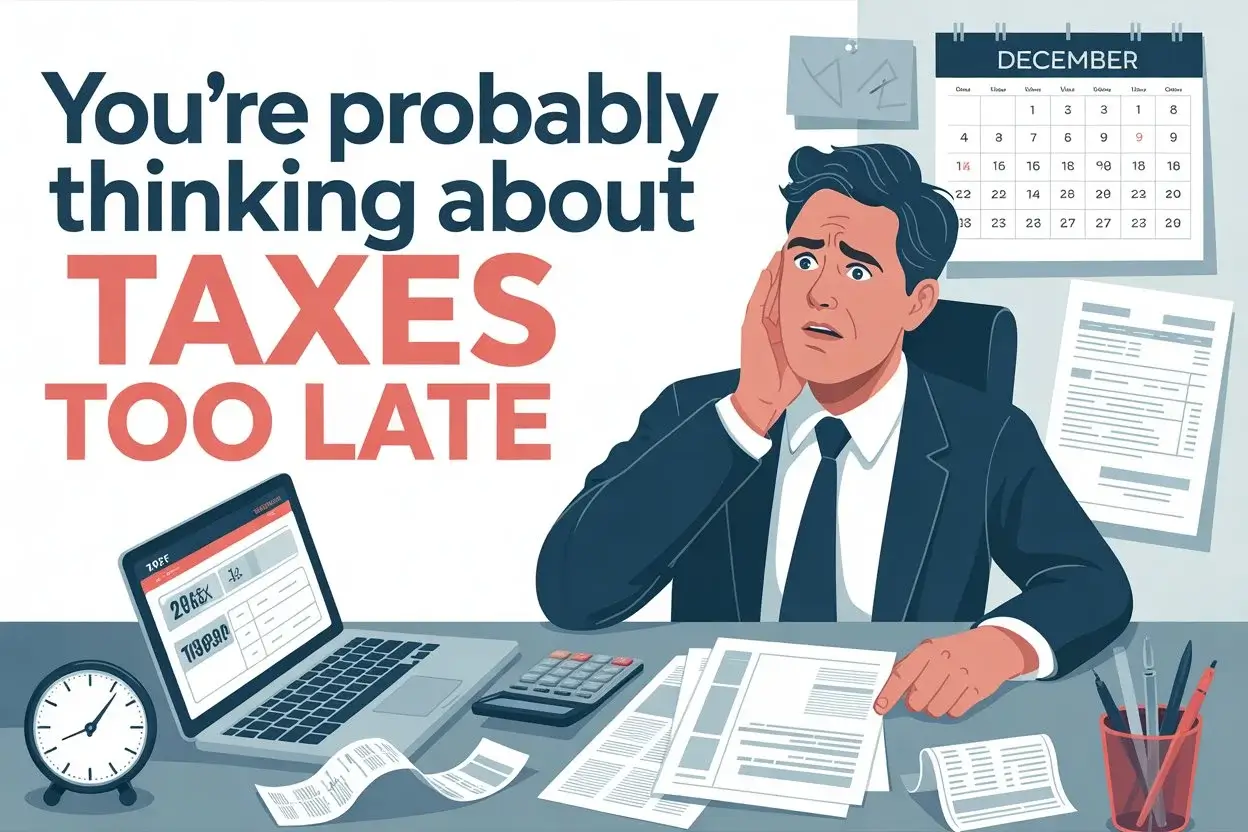
You’re Probably Thinking About Taxes Too Late
Most people think about taxes in March. They gather their forms, open a tab for TurboTax, and spend a few hours hoping their refund covers the stress. Then they close the laptop and don’t think about taxes again until next March.
Here’s the problem: by the time you’re filing, the year is already over. Every financial decision you made — how much you put in your 401(k), whether you sold that stock, whether you bothered with an HSA — is locked in. You’re not planning at that point. You’re just reporting.
Proactive tax planning is different. It’s deciding in May, or August, or even December, what moves you can still make before the year closes. Sometimes the difference between planning and not planning is a few thousand dollars. Over a decade of Coast FIRE savings, that gap can be meaningful.
The Gap Between Your Income and What Gets Taxed
Your taxable income isn’t the same as what your employer pays you. That distinction matters more than most people realize.
When you contribute to a traditional 401(k) or traditional IRA, that money comes out of your taxable income for the year. If you earn $80,000 and put $10,000 into a traditional 401(k), the IRS treats you like you earned $70,000. You still earned $80,000. You just reduced the amount you’ll be taxed on.
Health Savings Accounts (HSAs) work similarly — and are arguably even better because the money goes in pre-tax, grows tax-free, and comes out tax-free when used for qualifying medical expenses. If you have a high-deductible health plan and you’re not maxing your HSA, you’re leaving one of the few triple-tax-advantaged accounts on the table.
The point isn’t to chase deductions obsessively. It’s to understand that your tax bill isn’t a fixed outcome. It’s shaped by choices you make throughout the year, and most of those choices have to be made while the year is still happening.
Traditional vs. Roth: Timing Is the Whole Game
Whether to use a traditional or Roth account is one of the most debated questions in personal finance, and the honest answer is: it depends on your tax rate now versus your expected tax rate later.
Traditional accounts reduce your tax bill today. Roth accounts don’t give you a break today, but withdrawals in retirement are tax-free.
If you’re in a low tax bracket right now — maybe you’re early in your career, or you took time off, or your income dropped for a year — contributing to a Roth is often the smarter move. You pay taxes on the money now when the rate is low, and you never pay taxes on that money again.
If you’re in a high bracket, the traditional route usually wins. You defer the tax hit to retirement, when your income (and potentially your tax rate) will likely be lower.
The mistake people make is treating this as a permanent, one-size-fits-all decision. In reality, it makes sense to revisit it each year based on where your income actually lands.
Tax-Loss Harvesting Isn’t Just for Rich People
Tax-loss harvesting sounds technical but the idea is simple. If you have investments that are currently worth less than you paid for them, you can sell them, lock in that loss on paper, and use it to offset gains elsewhere in your portfolio — or even reduce your ordinary income by up to $3,000 per year.
Say you bought shares of a fund for $5,000 and they’re now worth $3,800. You’re sitting on a $1,200 unrealized loss. If you sell, you can use that loss to cancel out gains from other investments you sold at a profit, reducing how much you owe.
After selling, you can reinvest in something similar (just not the exact same security within 30 days, due to the wash-sale rule). Your portfolio stays roughly intact, but you’ve reduced your tax bill.
This only applies to taxable brokerage accounts, not retirement accounts. But if you invest outside of tax-advantaged accounts, it’s worth reviewing your positions toward year-end specifically with this in mind.
The Year-End Window (and Why It Closes Fast)
There’s a period between October and late December where a lot of tax planning options are still open. After December 31, they’re not.
A few moves worth considering before year-end:
Accelerating deductions. If you’re planning to make a charitable donation, doing it before December 31 means it counts for the current tax year. Same with paying a property tax bill that’s due in January — paying it in December could let you deduct it this year.
Harvesting losses as described above, if markets have created opportunities.
Reviewing your retirement contributions. If you haven’t maxed out your 401(k) for the year and your employer allows it, you might be able to increase contributions for your last few paychecks.
Bunching deductions. The standard deduction ($14,600 for single filers and $29,200 for married filing jointly in 2024) is high enough that most people don’t itemize. But if you’re close to the threshold, doubling up on charitable contributions or other deductible expenses in one year — then taking the standard deduction the next — can be more efficient than spreading them evenly.
None of these are loopholes. They’re just using the tax code as it’s written.
When Your Income Changes, Your Strategy Should Too
A lot of people set their tax strategy once and forget it. But income isn’t static. A raise, a side income, a job loss, selling a business, an inheritance — any of these can shift you into a different bracket or create a one-time planning opportunity.
The year you leave a high-paying job and your income drops significantly is often a great year for a Roth conversion. You take money from a traditional IRA, pay tax on it at your current (lower) rate, and move it into a Roth where it grows tax-free going forward.
The year you sell an investment property, you might have a large capital gain and need to think about how to offset it.
The year you retire — or partially retire, as is often the goal with Coast FIRE — is worth a full tax review because your income sources, rates, and available deductions all change at once.
The people who come out ahead on taxes aren’t usually doing anything complicated. They’re just paying attention to these transitions when they happen, rather than noticing them at filing time when it’s too late to do anything.
A Note on Working With a Tax Professional
For most straightforward situations, good tax software and your own research will get you far. But if you have self-employment income, rental properties, significant investments, or a complex financial picture, a CPA or enrolled agent can spot opportunities that software misses.
The key is talking to them before year-end, not in April. A good tax professional in March can tell you what happened. The same person in October can actually help you change the outcome.
The Real Takeaway
Tax planning isn’t a once-a-year sprint. It’s a series of smaller decisions spread across twelve months — some of them tiny, some of them genuinely significant. The investor who increases their 401(k) contribution in July and reviews their taxable account in November will almost always do better than the one who tries to fix everything in week two of April.
If you’re working toward Coast FIRE, every dollar you don’t send to the IRS unnecessarily is a dollar that stays invested. Given enough time and compound growth, those dollars matter. Not because of any individual year, but because of all of them added together.
Nothing in this article is tax advice. Tax laws change, and individual situations vary. Consider working with a qualified tax professional for guidance specific to your circumstances.