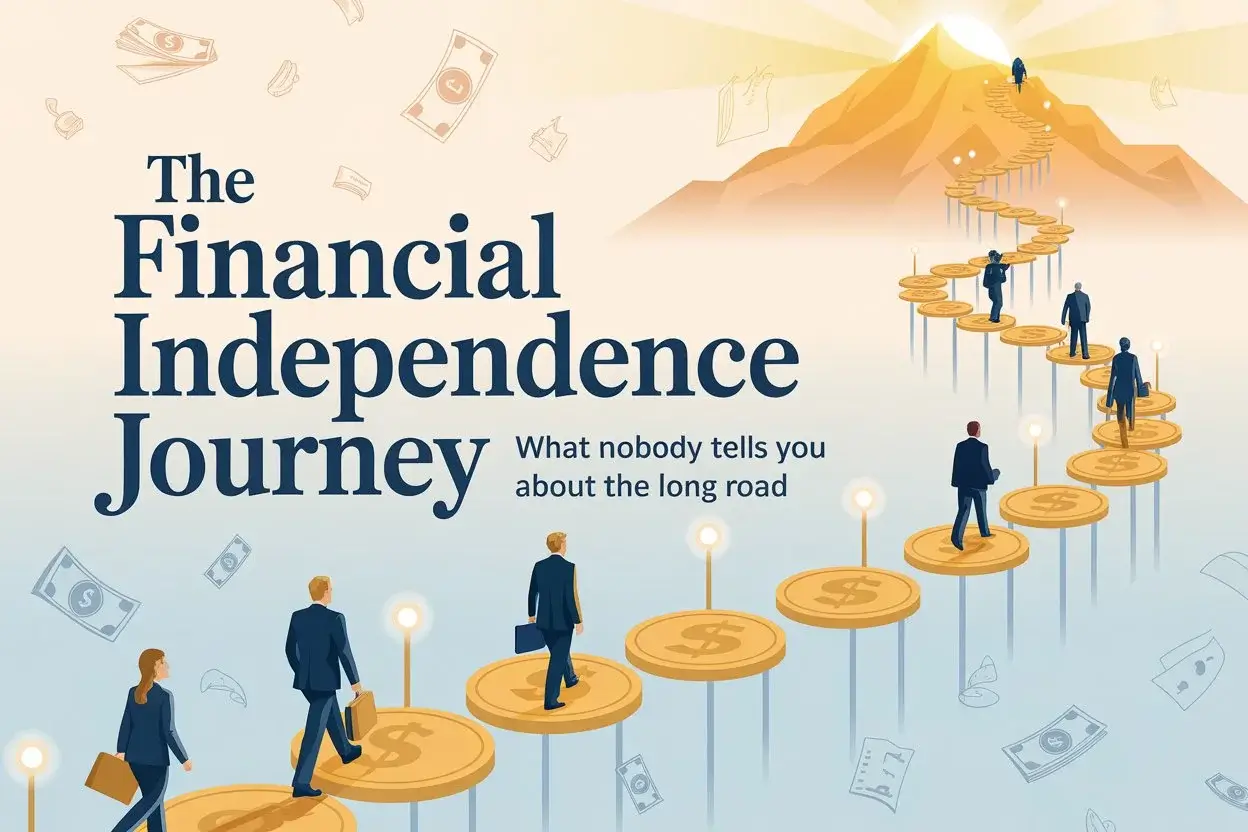
The Financial Independence Journey: What Nobody Tells You About the Long Road
Most people find out about financial independence the same way: they’re tired. Not sleepy-tired. The deeper kind — tired of wondering if the paycheck will stretch, tired of math that never quite works out, tired of trading the best hours of the day for money that feels like it disappears before it arrives.
That tiredness is actually a good starting point. It means something has shifted. And a shift, even an uncomfortable one, is where most real financial journeys begin.
This isn’t a guide about retiring at 35 or turning $500 into $50,000. It’s about something quieter and more durable: building a financial life that eventually stops demanding all of your attention. The path takes years, not months. But the people who actually reach financial independence — real independence, not just a better salary — tend to share a few things in common. Not investment strategies. Mindset patterns.
Phase One: Seeing the Full Picture (Even When It’s Ugly)
The first thing most people avoid is also the most necessary: knowing exactly where they stand.
Not a rough estimate. Not “I think I spend around X.” The actual number. What comes in, what goes out, and what’s left at the end of each month.
For a lot of people, this first accounting is uncomfortable. Someone who feels reasonably responsible might discover they’ve been spending $400 a month on things they couldn’t name ten minutes later. That’s not unusual. It’s also not a reason to panic or to punish yourself. It’s just data — and data is useful.
Take a 32-year-old teacher, call her Nadia Wallace. She made decent money, had no major debt besides a car payment, and still couldn’t figure out why her savings account never grew. When she finally tracked three months of spending, she found $600 going to subscriptions and small online purchases she’d long forgotten about. She wasn’t reckless. She was just not watching. Once she could see the pattern clearly, the fix was almost obvious.
The financial independence journey doesn’t start with investing. It starts with visibility.
Phase Two: The Gap — and Why It Matters More Than Income
Here’s the thing that surprises most people when they start paying attention: income is less important than the gap between income and expenses.
A person earning $120,000 a year and spending $118,000 is in a more precarious position than someone earning $65,000 and spending $40,000. The second person has a gap. That gap is where everything else gets built.
This is why early financial independence content so often focuses on frugality — not because poverty is the goal, but because closing the gap is the mechanism. Every dollar that doesn’t get spent is a dollar that can be deployed elsewhere. It gets invested, put toward debt, or held as a cushion. It starts working.
That said, there’s a limit to how far spending cuts can take you. At some point, you’ve already cut the subscriptions and the takeout and the impulse buys. What’s left is the fixed stuff: housing, transportation, insurance. If those costs are high, the only real lever left is income.
Both sides matter. The goal is a gap large enough to make steady progress — not so aggressive that the lifestyle becomes miserable, but real enough to move the needle month over month.
Phase Three: Debt Is a Direction, Not a Destination
Not all debt is the same, and one of the early mindset shifts of this journey is learning to tell the difference.
A 22% credit card balance and a 3.5% mortgage are both “debt” in the accounting sense, but they function completely differently. One is actively shrinking your financial future with each passing month. The other is, in most cases, close to neutral — especially if you’re in a market where property holds value.
The people who make fastest progress on financial independence usually attack high-interest consumer debt with real urgency. Not because they’re following a rule, but because they understand what compound interest does on the way down. The same math that builds wealth in an investment account destroys it in a credit card balance.
Once high-interest debt is gone, the psychological effect is noticeable. The monthly obligations drop. The feeling of being cornered lightens. That’s not imaginary. It’s a real change in cash flow, and it opens options.
Phase Four: Learning to Invest Without Overthinking It
At some point in this journey, the gap is real, the worst debt is gone, and there’s money left over. Now what?
This is where a lot of people stall. They feel like they need to understand everything before they start — every account type, every fund, every tax implication. That hesitation is understandable, but it costs more than most people realize. Time in the market matters. A lot.
The basic version of investing for long-term wealth isn’t complicated. A low-cost index fund inside a tax-advantaged account (a 401k, an IRA, or both) is where most people should start. That’s not a compromise. That’s genuinely what most financial research suggests works well over long time horizons.
Consider a 28-year-old who puts $400 a month into a broad market index fund and earns an average annual return of 7%. In 30 years, with no changes, that’s roughly $490,000. Not because they picked the right stocks. Because they started, stayed consistent, and left it alone.
The enemy of investing isn’t complexity. It’s delay.
Phase Five: The Middle Years — Boring on Purpose
There’s a stretch in every long financial journey that doesn’t feel like progress. The debt is handled, the accounts are set up, the money is going where it should. But the numbers don’t feel dramatic yet. This phase has a name in some corners of the financial independence community: the messy middle.
It’s boring on purpose. And that’s actually the sign that things are working.
During this phase, the most important skill is staying out of your own way. Not checking your investment account after every market dip. Not chasing a new strategy every six months. Not inflating your lifestyle every time income goes up — a habit known as lifestyle creep, which silently closes the gap that took years to build.
Lifestyle creep is worth naming specifically, because it’s sneaky. When income rises, it feels natural to upgrade things proportionally. New car, bigger apartment, nicer everything. Some of that is fine. But if spending rises as fast as income, the gap never widens. Ten years pass and the numbers are bigger but the position is roughly the same.
The people who make it through this phase intact tend to have one thing in common: they defined what “enough” looked like before the money showed up. Not in a restrictive way — in a values-based way. They knew what they actually wanted their life to look like, so they could upgrade toward that and ignore everything else.
Phase Six: Net Worth as a Compass, Not a Trophy
Somewhere in the middle of this journey, people start tracking net worth. Assets minus liabilities. One number.
It’s useful, but it carries a risk: turning into a scorecard. A reason to feel bad on down months and smug on good ones. The people who handle it best treat it more like a compass than a trophy — a directional tool that answers the question “am I generally moving the right way?” rather than “am I winning?”
Net worth also teaches patience in a way that monthly budgets don’t. Month to month, the changes feel small. Zoom out to five years and the trajectory is often genuinely surprising — in a good way.
Phase Seven: Rethinking What “Independence” Actually Means
Here’s where the journey gets more personal.
Financial independence is often defined as having enough invested that your returns can cover your expenses indefinitely. There’s a common formula — the 4% rule, or variations of it — that gives this a rough number. It’s a useful framework. But it’s worth asking what the goal actually is.
For some people, it’s full retirement. For others, it’s the ability to work less, or to choose work they’d do even if the pay were lower. Some people reach a point of basic security and realize that’s enough — that they don’t need the full number, just enough buffer to make different choices.
The common thread isn’t a specific dollar amount. It’s optionality. The ability to say no to things that don’t fit. The freedom to slow down without it being a crisis.
That’s the real destination: not a number, but a different relationship with time and money.
What the First Step Actually Looks Like
If you’re early in this, the whole thing can feel abstract. So here’s a concrete entry point.
This week, pull up your last three months of bank and credit card statements. Not to beat yourself up — just to see. Add up what’s actually going in and what’s going out. Find the gap, or notice that there isn’t one yet.
That’s it. That’s the beginning.
The financial independence journey is long and it doesn’t look dramatic for most of it. But it compounds, the same way the investments do. The clarity gets clearer. The options multiply. And at some point — later than the internet suggests but sooner than it feels possible — you’ll look up and realize the relationship between your time and your money has quietly, permanently changed.
That’s worth starting for.
coastfirecalc.com helps you model your own path to Coast FIRE — the point where your current savings, left alone, will grow to fund your retirement. Try the calculator to see where you stand today.