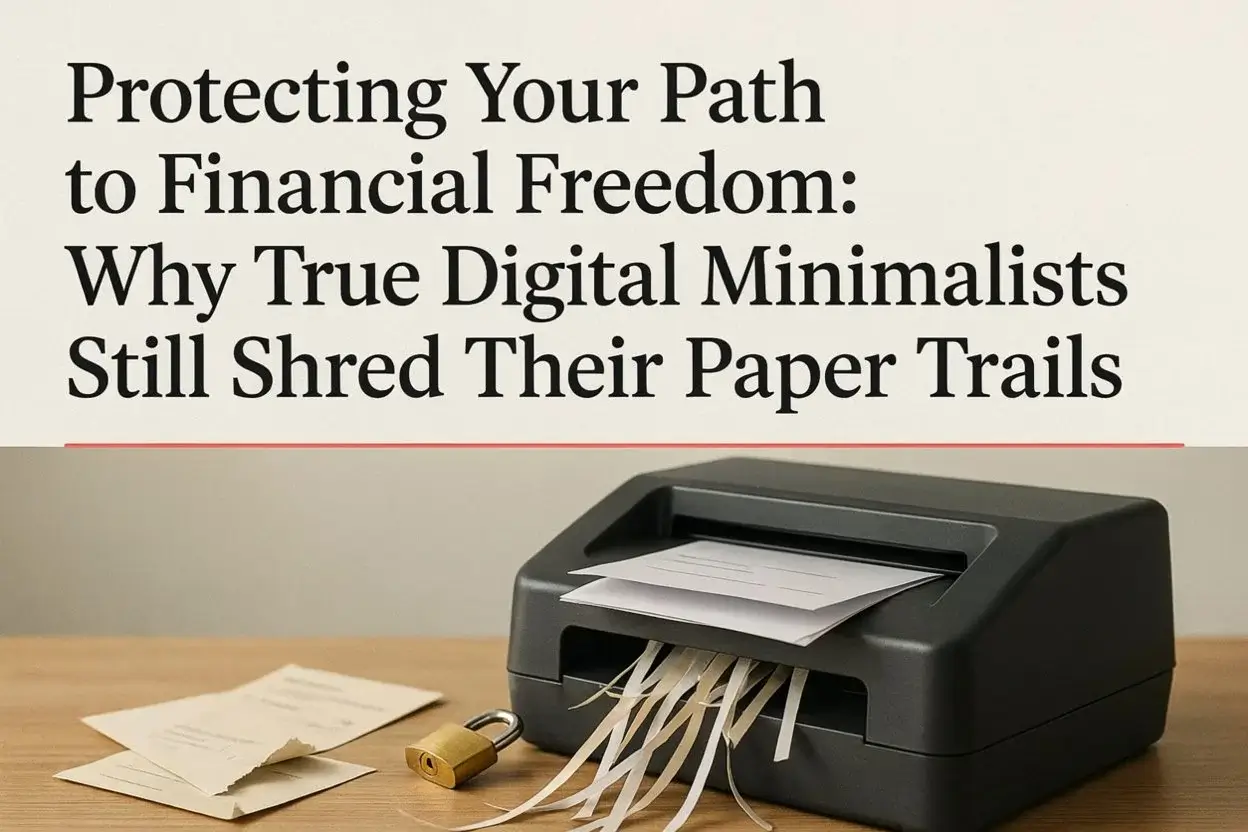
Protecting Your Path to Financial Freedom: Why True Digital Minimalists Still Shred Their Paper Trails
The way we view trying to reach Coast FIRE is typically that of pure optimization.
We analyze our investments and aim to save more each month.
We audit all our monthly subscriptions to make sure we are only spending money on what we value. And finally, we try to download as many apps as possible that offer the highest level of security in the digital world of finance.
But in trying to reach our optimal timeline to financial freedom, we all have a blind spot.
There is a blind spot in the hyper-focused digital security mindset that dominates discussion about reaching Coast FIRE.
You’ve probably set up two-factor authentication for your online brokerage accounts and downloaded an encrypted app for your mobile phone.
But, while you’re busy securing your digital financial life, have you thought about the physical documents sitting in your home in shoeboxes, filing cabinets, and recycling bins?
The paper trail from past tax returns, bank and investment statements, stock certificates, and even junk mail with pre-approved credit offers for accounts you opened years ago can be used by identity thieves to access your financial life.
In the end, it’s your physical documents that can pose the greatest risk to your hard-earned finances, even when you have the best digital security in place.
So, have you looked at the paper trail on your desk recently?
We assume the old-school stuff doesn’t matter anymore.
The Real Cost of a Security Breach
Your money growing to retirement age is delicate. It’s very easy to destroy a lot of money in a very short period of time.
And, as we’ve already discussed, preventing identity theft to protect your timeline to financial independence is a huge security concern for those of us trying to coast to retirement.
I identify with your desire to protect your life’s work.
To that end, I want to point out the average time required to resolve an identity theft case and the related costs.
According to USAToday, the average amount of time it takes to resolve an identity theft is 6 months of your life.
And, during that time, you could be spending your time and energy rectifying the problem instead of waiting; you will also likely have to spend a significant amount of money to put the situation right.
This could require you to dip into your retirement savings at a time when you were planning not to.
And that is exactly what we want to avoid. We work from our homes more and more, and our homes are the center of our work.
This means that the line between our work life and our personal life is very blurry.
So, when we print out our quarterly investment reports, our closing documents for our home purchases, and years of tax returns, we need to make sure that we store them in a safe and secure location, not just a random box in the basement.
Why San Jose Is a Hotspot for Document-Based Identity Theft
Most people assume that when they put financial papers in the recycling bin, they are disposed of forever.
However, in today’s society of local, same-day identity theft, there is a large group of people called document scavengers who go through recycling bins looking for financial documents to use for identity theft.
Is it worth taking the risk of having your future financial problems?
San Jose is a particularly attractive target for this kind of crime. As the largest city in Silicon Valley and the unofficial capital of the tech industry, San Jose has one of the highest concentrations of high-income, dual-tech-salary households in the country. Neighborhoods like Willow Glen, Almaden Valley, Rose Garden, and Evergreen are exactly the kind of stable, affluent residential areas that document scavengers learn to target on trash and recycling collection days.
Add to that the sheer density of the South Bay, where curbside bins sit out overnight along quiet residential streets from Cambrian Park to Berryessa, and you have a city that offers both plenty of financial upside for a thief and plenty of cover. A single walk down a block the night before pickup can yield tax documents, brokerage statements, and pre-approved credit offers from a dozen different homes.
San Jose’s own municipal recycling guidance encourages residents to remove personal information from paper before it goes to the curb, precisely because curbside bins are not a secure disposal method. Once documents leave your hands in an unshredded state, you have no way of controlling who sees them between your driveway and the recycling facility.
To protect your financial data from local thieves, use local resources to securely destroy paper documents, such as financial records, medical histories, and other sensitive personal identifiers. This removes the largest risk factor, the human element, from your physical data disposal. Utilizing secure paper shredding in San Jose, for example, is the safe and smart thing to do.
Because so much of the South Bay’s workforce is concentrated in tech, finance, and biotech, a single compromised identity in San Jose can also be unusually lucrative for a thief, thanks to higher-than-average credit limits, larger brokerage balances, and equity compensation records that reveal exactly how much a household is worth. That makes routine, local, professional shredding less of a nice-to-have and more of a core part of a San Jose resident’s financial security stack.
Building a Physical Security Routine
Adding physical security to your financial life doesn’t have to be a huge change to how you currently operate.
Create a routine, stick to it, and you’ll be protecting your financial future in no time.
For starters, implement a one-in, one-out policy for paper.
This means for every new piece of paper that comes into your life, one has to go out the door. Typically, most financial institutions offer their statements online for download (even if only for a limited time).
So, for instance, even if you needed to keep a copy of last year’s tax return in physical form, you could scan it and keep it on your encrypted hard drive.
This would be far better than keeping the physical copy around.
So, where do you start?
Store physical documents until you need to destroy them.
Treat old mail the same way you treat digital information: hold it in a locked bin until you can shred or incinerate it.
Many people treat information printed on paper differently from information on their computer. That information is just as sensitive and deserves the same respect and protection.
Third, audit your storage annually.
Every tax season, review your older files and determine what can be safely purged. Generally, the IRS recommends keeping tax returns and supporting documents for three to seven years, depending on the complexity of your filing.
Once that window passes, those documents should be permanently destroyed. For San Jose residents, this is also a good time to schedule a recurring drop-off or pickup with a local shredding provider, so the purge actually happens instead of turning into another box in the garage.
The Peace of Mind Dividend
The core philosophy of Coast FIRE is to save enough in the early years to buy back your time and reduce your anxiety levels in the later years of your working life.
Saving for retirement while you are young and earning high incomes to allow your retirement savings to grow is the core philosophy of Coast FIRE.
But saving for retirement while you are young to allow your retirement savings to grow, to buy back your time and reduce your anxiety levels in the later years of your working life, is a very fragile endeavor if you do not also secure the physical world of financial documents and other physical factors that can impact your financial well-being.
Securing the physical world, the area where the greatest amount of financial damage can occur with the least amount of time and effort to correct, is like buying a form of portfolio insurance.
It is inexpensive, and by locking down all the physical areas where you could run into problems, including the paper piling up in a San Jose garage or home office, you can ensure that a preventable error does not undo your solid financial planning.