
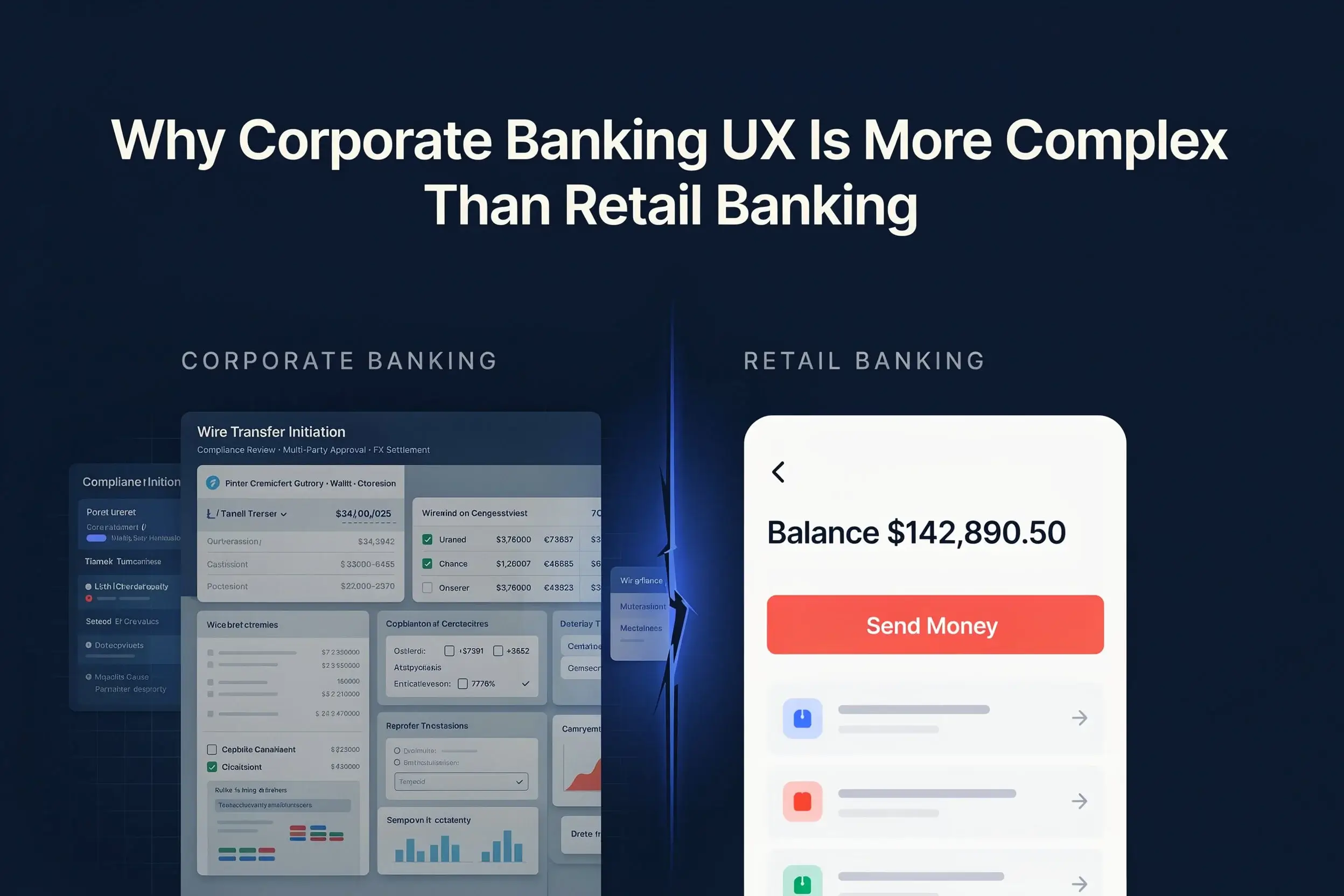
Why Corporate Banking UX Is More Complex Than Retail Banking
TL;DR
Corporate banking UX is significantly more complex than retail banking due to multiple user roles, approval workflows, compliance requirements, and high-value transactions. Design must prioritize efficiency and control over simplicity alone.
Introduction
Corporate banking platforms operate in a fundamentally different environment compared to retail banking systems.
While retail banking focuses on individual users managing personal finances, corporate banking supports entire organizations with complex financial operations.
These systems must accommodate multiple roles, approval hierarchies, regulatory constraints, and high-stakes transactions.
As a result, UX design in corporate banking requires a different approach.
Why Corporate Banking Is Inherently Complex
Corporate financial environments involve:
- Multiple decision-makers
- Structured approval workflows
- Large transaction volumes
- Regulatory compliance requirements
- Internal financial policies
A single action often involves several stakeholders.
User Roles in Corporate Banking Systems
| Role | Responsibility |
| Finance Manager | Daily operations |
| Treasury Specialist | Liquidity management |
| CFO | Strategic oversight |
| Accountant | Reporting and reconciliation |
| Auditor | Compliance verification |
Each role requires different permissions and views.
Key UX Challenges in Corporate Banking
1. Role-Based Complexity
Users see different interfaces depending on their responsibilities.
2. Approval Workflows
Transactions often require multi-step approvals, increasing friction if not designed properly.
3. High-Stakes Transactions
Errors can lead to significant financial consequences.
4. Compliance Requirements
Regulatory rules add additional layers of validation and documentation.
Designing for Enterprise Efficiency
Unlike consumer apps, corporate banking UX must prioritize:
- Speed of execution
- Accuracy
- Transparency
- Permission control
- Auditability
Efficiency is more important than visual simplicity.
Why Legacy Systems Fail Users
Many corporate banking platforms are built on outdated infrastructure.
Common issues include:
- Complex navigation structures
- Inconsistent workflows
- Lack of role customization
- Poor data visibility
- Slow performance
These problems reduce productivity and increase operational costs.
Modern Approaches to Corporate Banking UX
Modern platforms focus on:
- Role-based dashboards
- Streamlined approval flows
- Real-time transaction tracking
- Modular interface design
- Contextual information display
Organizations modernizing these systems often invest in сorporate digital banking design services to redesign workflows around real enterprise needs.
Key Design Principles
1. Clarity in High-Pressure Environments
Users must immediately understand transaction status and required actions.
2. Reduction of Cognitive Load
Interfaces should minimize unnecessary complexity.
3. Predictable Workflows
Users should always know what happens next.
4. Strong Permission Architecture
Access must be clearly structured and easy to manage.
Conclusion
Corporate banking UX is not simply a scaled-up version of retail banking UX.
It is a fundamentally different domain requiring specialized design approaches focused on workflows, roles, and operational efficiency.
FAQ
Why is corporate banking more complex than retail banking?
Because it involves multiple users, approvals, and large-scale financial operations.
What is role-based UX design?
It is a design approach where interfaces adapt based on user responsibilities.
Why do banks redesign corporate platforms?
To improve efficiency, reduce operational errors, and support digital transformation.
What is the main goal of corporate banking UX?
To optimize complex workflows while maintaining accuracy and compliance.