
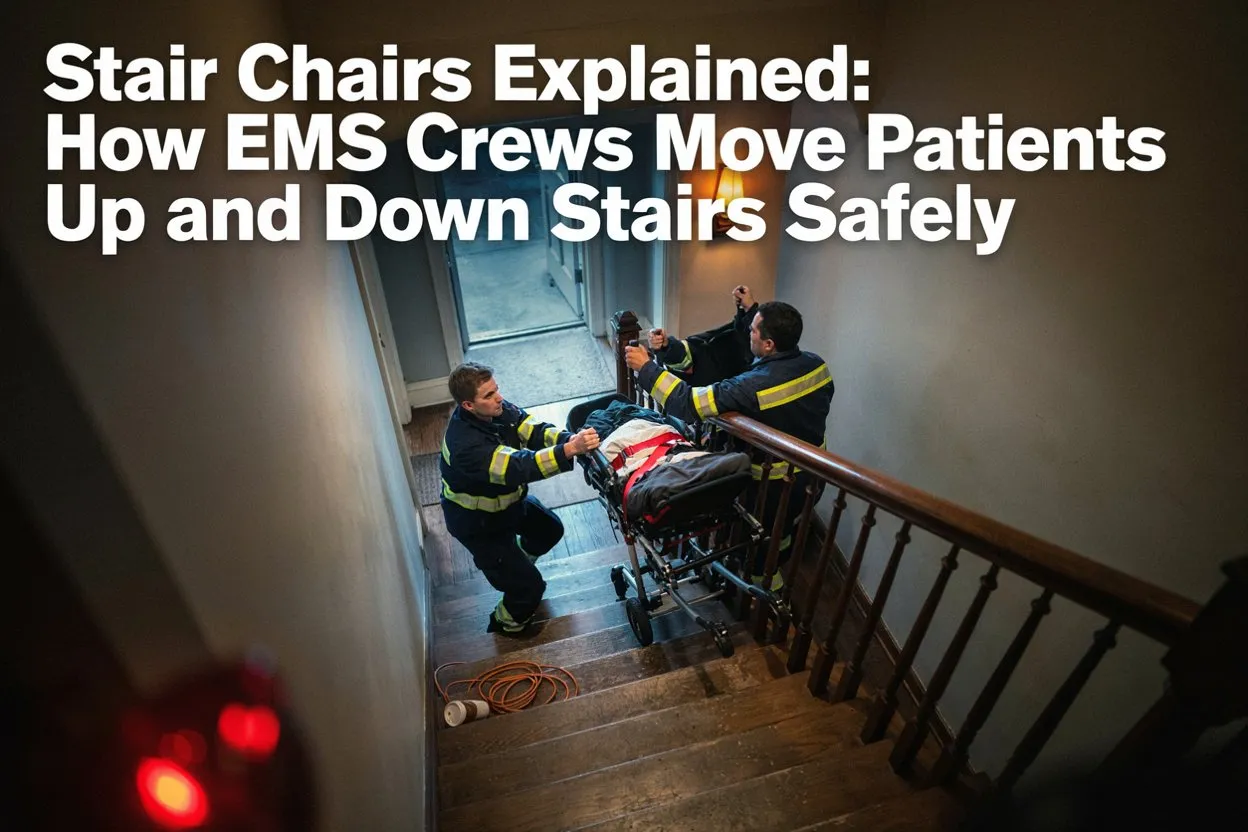
Stair Chairs Explained: How EMS Crews Move Patients Up and Down Stairs Safely
Ask a paramedic what part of the job most often leads to injury, and you will rarely hear about the dramatic calls. More often it is the ordinary, physical task of moving a patient, and the single most dangerous version of that task is navigating stairs. A narrow staircase in an old building, a tight turn on a landing, or a patient who cannot bear any weight can turn a routine transport into a real risk for both the patient and the crew. This is why the stair chair, a piece of equipment most members of the public have never heard of, is one of the most important tools an emergency team carries.
Why stairs are such a serious problem
On flat ground, a wheeled cot handles most of the work. Stairs remove that option entirely. Suddenly the crew is carrying the full weight of a patient at an awkward angle, often in a confined space, while trying to keep the patient stable and themselves from falling. A misstep does not just risk dropping the patient. It can cause the back and shoulder injuries that end careers in emergency services.
The numbers back this up. Patient handling, and stair work in particular, accounts for a large share of the musculoskeletal injuries that EMS workers suffer over their careers. The physical toll is cumulative, building over years of lifting, twisting, and carrying. Good equipment is the main thing standing between a crew and that slow wear, which is why services treat stair chairs as essential rather than optional gear.
What a stair chair actually is
A stair chair is a lightweight, foldable seated carrier designed to move a patient who can sit upright but cannot safely walk down or up stairs. The patient is secured into the chair with straps, and two crew members, one at the top and one at the bottom, guide it down the stairs in a controlled motion. Folded, the chair is compact enough to carry into a building and store in the ambulance alongside the main cot.
The design solves the core problem of stairs: it keeps the patient in a stable, secured position while distributing the physical demand between two responders in a manageable way. Compared to improvising with a blanket carry or trying to walk a weak patient down stairs, a proper stair chair is dramatically safer for everyone involved.
Manual tracked chairs versus powered chairs
Stair descent equipment comes in two broad categories, and the difference matters a great deal for crew safety.
Manual stair chairs with tracked glides are the workhorses of the field. Instead of lifting and lowering the chair step by step, the crew engages a set of rubber tracks or glides that let the chair slide smoothly and steadily down each stair. This takes much of the lifting strain out of the descent, because gravity and the track system do the work while the responders mainly guide and control the speed. These chairs are reliable, relatively affordable, and quick to deploy, which makes them a standard choice for many services.
Powered stair chairs go a step further. A battery-driven track system carries the patient down the stairs under motorised control, so the crew does even less lifting and the descent is exceptionally smooth and controlled. These are especially valuable for heavier patients and for services that run a high volume of calls in multi-storey buildings, where the cumulative strain on crews would otherwise be severe. The trade-off is a higher purchase cost and the need to maintain and charge the batteries. Many services weigh the upfront expense against the long-term savings in reduced crew injuries and lost work time.
For teams building or upgrading their fleet, it helps to buy from a supplier that stocks both types and the parts to keep them running. A dedicated range of stair descent equipment for EMS crews makes it easier to match the chair to the service’s call profile, whether that means rugged manual tracked chairs for general use or powered models for high-rise and bariatric work.
Weight capacity and the bariatric reality
One factor that increasingly drives equipment choices is weight capacity. Standard stair chairs are often rated around 350 to 500 pounds, but services are seeing more calls involving heavier patients, and a chair that cannot safely carry a patient creates both a clinical and a liability problem. Many teams now keep higher-capacity chairs on hand, and powered models are particularly useful here because the motorised system removes the dangerous strain of manually controlling a heavy load on stairs. Choosing the right capacity is not about planning for the average call. It is about being ready for the hardest one.
Training and technique still matter
Even the best equipment only works in trained hands. Crews practise stair chair technique repeatedly: how to position themselves, how to communicate during the descent, how to control speed, and how to secure the patient properly before moving. The equipment reduces the physical demand, but the coordination between the two responders is what keeps the descent safe. A good service pairs quality chairs with regular training, because one without the other leaves gaps.
Technique also protects the equipment’s value. Chairs that are used correctly and maintained well, with worn glides and straps replaced on schedule, last for years and perform reliably when it counts. Running equipment to failure is a false economy in a field where a single failed descent can injure a patient or a crew member.
The quiet importance of the stair chair
Most people will never think about a stair chair until the day one carries them or a loved one safely down to a waiting ambulance. For the crews who use them every shift, though, these chairs are among the most valued tools they own. They turn one of the most dangerous parts of the job into something controlled and repeatable, protecting patients from a frightening descent and protecting responders from the injuries that physical work would otherwise guarantee. Behind every smooth, stable trip down a staircase is a well-chosen piece of equipment doing exactly what it was built to do.
Frequently asked questions
What is a stair chair used for?
A stair chair is a foldable seated carrier used by emergency crews to move a patient up or down stairs safely when a wheeled cot cannot be used. The patient is strapped in and guided by two responders.
What is the difference between a manual and a powered stair chair?
A manual tracked stair chair uses glides or tracks that let it slide down stairs while the crew guides it, reducing lifting. A powered stair chair uses a battery-driven track system to carry the patient under motorised control, further reducing strain, at a higher cost.
How much weight can a stair chair hold?
Standard models are often rated between about 350 and 500 pounds, while higher-capacity and powered models are available for heavier patients. Services increasingly keep higher-capacity chairs to handle a wider range of calls safely.
Why are stairs so risky for EMS crews?
Stairs force crews to carry a patient’s full weight at an awkward angle in confined spaces, which is a leading cause of back and shoulder injuries in emergency services. Proper stair descent equipment greatly reduces that risk.
Do crews still need training if they have good equipment?
Yes. Equipment reduces the physical demand, but safe descents depend on coordination, communication, patient securing, and speed control between the two responders. The best services pair quality chairs with regular hands-on training.