Scenario Planning Software for Navigating Uncertain Financial Futures
Effective Coast FIRE planning depends on understanding how unpredictable forces, like market returns, job changes, and inflation, can impact your path to early financial independence. Scenario planning software offers a way to see beyond single-number forecasts and test how different futures might affect your Coast target.
Unlike traditional retirement calculators that promise a single projected number or date, scenario planning software helps you visualize a range of possible financial futures. This matters for Coast FIRE because your plan’s outcome depends as much on the sequence of events as on long-term averages. Factors such as market fluctuations, inflation spikes, or a career pause can dramatically alter your timeline.
For many seeking resilience in their plans, specialized forecasting software can model not just the most likely future, but also a spectrum of risks and opportunities. Outside personal finance, parametrics insurance software uses defined triggers to model how shocks may affect outcomes, a useful reminder that assumptions should be tested rather than taken as fixed. For example, a planner might want to see what happens to Coast FIRE if they pause contributions for five years due to a sabbatical, or if they experience a sudden expense spike such as relocating to a city with higher housing costs. Early on, you might explore simple best- and worst-case returns, but over time, real-life scenarios become just as important as the mathematical ones.
What Coast FIRE planners need from scenario tools
The core inputs that drive Coast FIRE projections are simple to describe but vital to get right. The essentials include your current invested portfolio, your target annual spending (in future dollars), expected annual contributions before “coasting,” and the number of years until your target financial independence date. But while these numbers produce a clean projection, reality often demands more flexibility. The concept of “coasting” should be treated as a range of possible milestones, not a fixed finish line, since any number of factors could move you closer or further away from your goal.
Seasoned users frequently revisit their assumptions as markets shift or personal circumstances evolve. For instance, even a modest change in ongoing contributions—pausing contributions during a career break or after a part-time transition—can significantly affect when, or if, you can stop saving entirely and let compounding do the rest. Suppose you plan to switch from full-time to part-time work in three years, reducing your savings rate by half. Scenario tools allow you to test how this change might delay, accelerate, or otherwise modify your Coast FIRE path by inputting and evaluating these shifts directly.
Scenarios worth testing for a robust plan
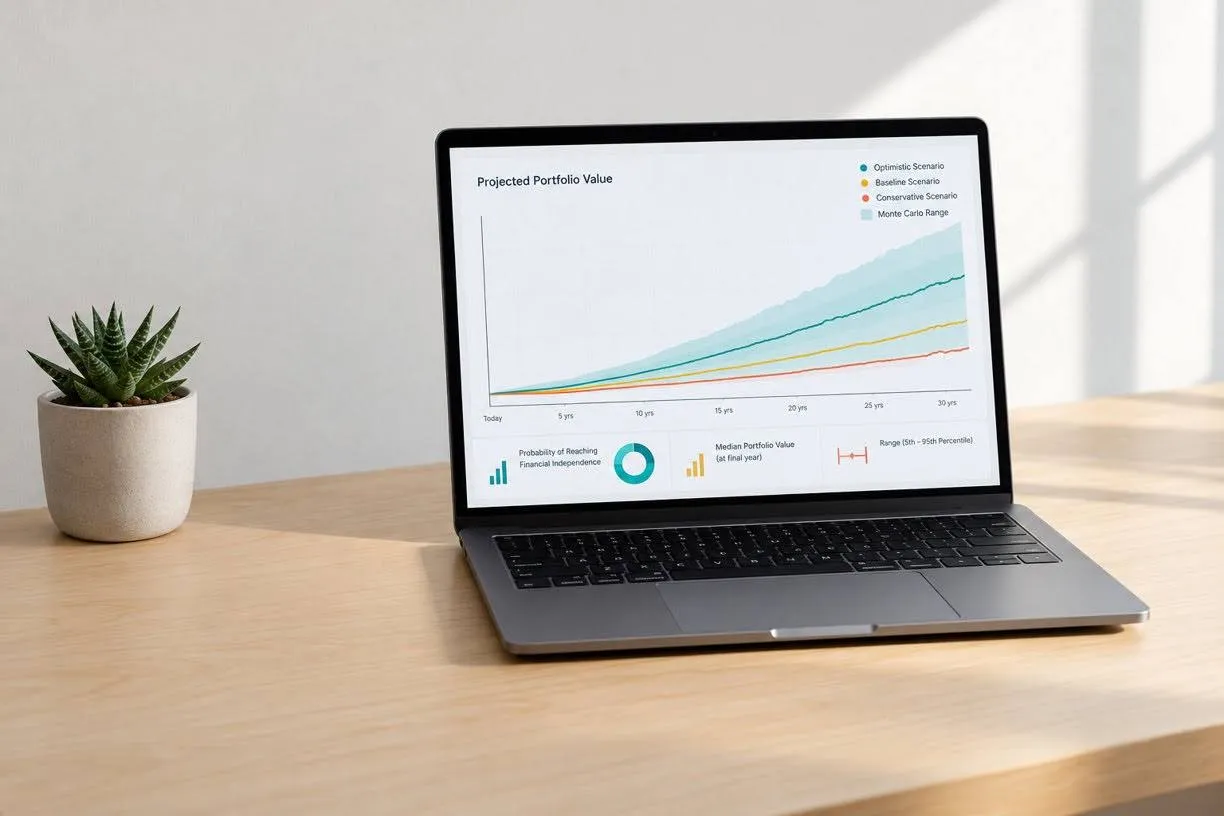
Modeling a single scenario ignores the main lesson of financial history: the future rarely unfolds in a straight line. Most scenario planning software allows you to compare baseline, optimistic, and conservative projections. A baseline might assume long-term average returns and inflation, while a conservative path could lower return assumptions or increase inflation to highlight downside risk. For instance, testing a scenario where you experience three consecutive years of negative market returns right after you stop working full-time demonstrates the potential impact of sequence-of-returns risk—a real concern for Coast FIRE planners.
Unexpected inflation can erode purchasing power, especially in the years after you “coast.” Including Consumer Price Index data when reviewing higher- or lower-inflation variants can help ground those assumptions in observed price changes. For example, one scenario might model 3 percent annual inflation, while another assumes 5 percent during the first ten years. Similarly, income volatility, such as a sabbatical or switching to part-time work, warrants scenarios where contributions drop or stop for a period, allowing you to see whether your investments can still carry you to your goal. Real-life examples include modeling for extended parental leave, a late-career layoff, or early semi-retirement. In the insurance space, trigger-based tools help model outcomes based on specific financial or natural triggers. These allow users to simulate the effect of sudden changes on revenue streams or portfolio values, providing insight into how insurance mechanisms can address unpredictable risks alongside Coast FIRE strategies.
Other scenarios worth including are one-time shocks, like a major health expense, and recurring increases such as rising property taxes or supporting a family member. For example, test a situation where you need to cover unexpected medical bills for a year, or if your expenses rise permanently due to a new dependent. Each test helps you see not only when you might reach Coast FIRE but also how robust your plan is against life’s inevitable surprises.
Features that make software genuinely useful
Practical scenario tools stand out by letting you compare multiple models side-by-side, making trade-offs and impacts immediately visible. For example, you might run three versions of your plan: one where you maintain high contributions, one with moderate contributions but higher expected expenses, and one with a lengthy pause in saving. You can see how each impacts your projected success and timeline by comparing the outcomes directly.
Some software uses deterministic forecasting, calculating results with fixed inputs. Others use Monte Carlo simulations, running thousands of possible outcomes based on randomized variables such as yearly returns or inflation rates. Monte Carlo is particularly effective at highlighting the full range of possible results and showing the likelihood of hitting your Coast target under different conditions. As an example, after running a Monte Carlo simulation, a Coast FIRE planner might discover that with present assumptions, there is a 75 percent probability of reaching the target by 2038, but only a 50 percent probability if contributions drop by 25 percent for five years.
Advanced tools often offer sensitivity analysis to reveal which assumptions, like return rates or contribution levels, matter most. This enables you to focus on adjusting the factors that actually drive your outcomes. For instance, by tweaking the expected investment return within the tool, you may find that adjusting your contribution by even $50 per month is more impactful than reducing annual spending by $500 in retirement. These kinds of analyses help prioritize what changes make the most difference.
Another useful feature is the ability to save different assumption sets, make notes, and track changes over time. For example, after a major life event such as moving or changing jobs, you can save a revised scenario and compare it against earlier versions. This allows you to revisit plans as your life and the economy evolve, providing a valuable audit trail and helping you understand what changed and why.
Interpreting outputs and staying level-headed
Financial models can create a false sense of precision, especially when they report “success rates” down to decimal points. It is important to understand the difference between probability bands (such as an 80 percent chance of reaching your goal) and guarantees. Sensible use of scenario planning means paying attention to decision-relevant thresholds rather than fixating on the illusion of exact predictions.
Stress-testing withdrawal rates is crucial, particularly if you plan to trim contributions or transition to semi-retirement. For example, you could run scenarios where your market returns disappoint in the first decade and see whether your planned withdrawals remain sustainable. Running scenarios that push the boundaries of your “coasting” assumptions helps ensure you do not run out of money if reality is less kind than your base case expectations.
A practical Coast FIRE check-in routine
Most Coast FIRE adherents benefit from a check-in every few months. A typical workflow includes updating account balances, revising contributions if your income or expenses shift, and re-running the most important scenarios. For example, after a pay raise or a significant expense, adjust your projections and compare how updated scenarios affect your Coast timeline. If the outputs show that you are drifting off course, this is the moment to decide whether to tighten spending, bump up savings, or adjust your timeline.
Making these check-ins routine keeps your plan flexible, helping you avoid big surprises without obsessing over every market swing. Scenario planning is best used as a support for decision-making, not a crystal ball, and its value comes from helping you adapt as needed, especially in a world where financial conditions may remain unpredictable through 2026.