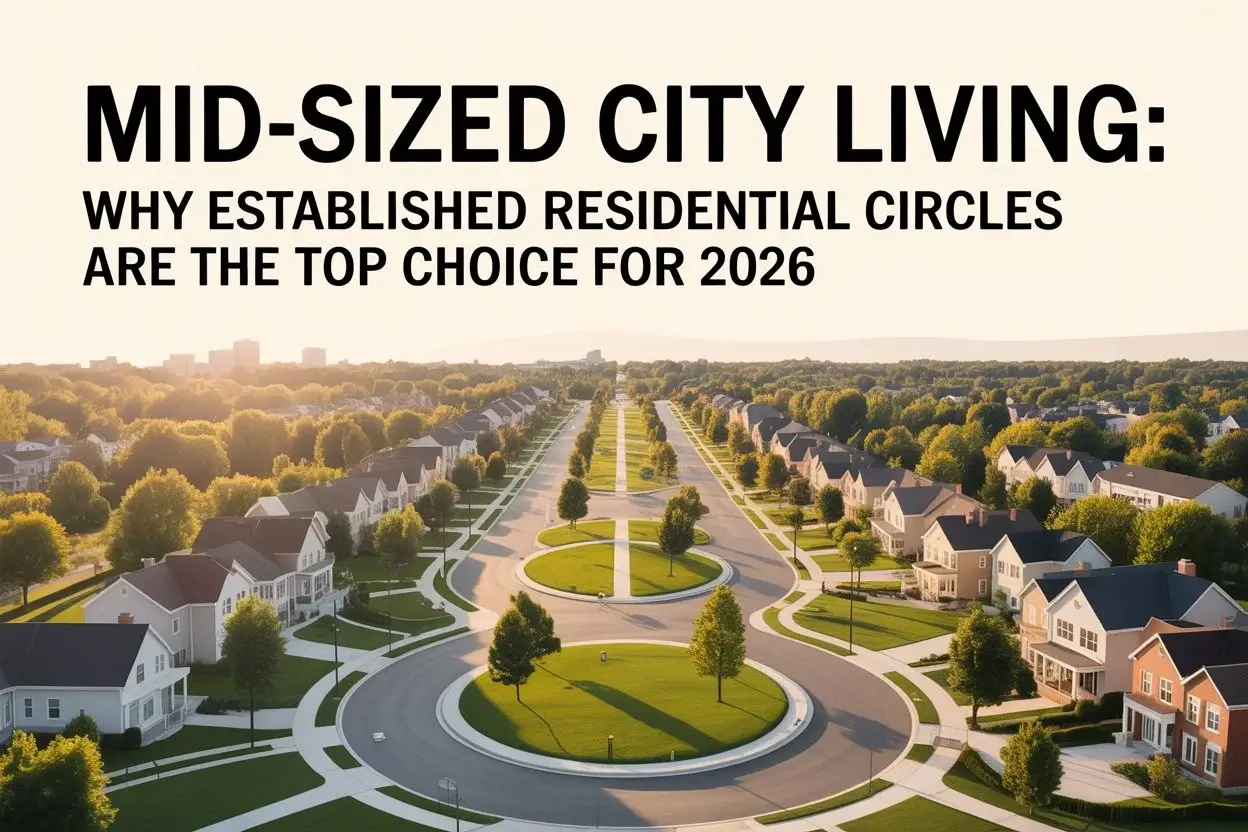
Mid-Sized City Living: Why Established Residential Circles are the Top Choice for 2026
Cities like New York, Los Angeles, and Miami have always dominated the real estate market. But in 2026, we are noticing a change in buyer behavior..
You see, more households are moving toward mid-sized cities. To be more specific, toward established residential neighborhoods within those cities. A major reason is thought to be the insane living cost in big cities. Then there are factors like living space, neighborhood stability and in general, better lifestyle.
But these are just surface level assumptions. Let’s dive deep and figure out exactly why mid-sized-city-living in established residential circles is the top choice in 2026.
Why Established Neighborhoods Feel More Stable
Today in many metro areas, the growth rate of home price has exceeded the average income. The gap is even higher in some coastal markets. There, median home prices easily cross $1M. But that’s not the only reason. There are more. Have a look.
Long-Term Infrastructure Already Exists

By established neighborhoods, we mean residential areas that are close to healthcare, retail shops, schools and parks. That’s one level up from typical suburban areas where residents have to drive for hours just to get basic services.
Moreover, families increasingly prefer districts with long-term academic performance data. A less-known school in a somewhat new neighborhood can’t guarantee top-notch education. That’s why many parents are choosing older and established circles.
Larger Lot Size
Lot size comparisons tell a very interesting story.
In many high-growth metro suburbs that were built after 2020, average lot sizes shrank considerably. That’s because developers attempted to maximize land efficiency.
Meanwhile, older neighborhoods in mid-sized cities still feature wider yards, and more green space around each house.
That space difference becomes especially important for buyers who prioritize outdoor living, or have young kids.
Predictable Property Values
What many new investors don’t understand is that most markets experience an appreciation in price during boom cycles. But, that’s short-lived. The market can show signs of volatility soon after. That’s just how the cycle works. After all, short-term migration trends don’t reflect stronger property value in the long term.
If you are not up for the risk, a good alternative can be established neighborhoods in mid-sized cities. The housing prices here appreciate at steadier rates. That’s because the demand remains solid yet diversified. So, you know it’s more than passing a trend.
After all, families always want schools nearby, shorter commutes to the workplace and accessibility to nature. That layered demand base creates resilience.
Easier Transportation

Transportation access creates another big advantage. You see, in oversized metro areas like Atlanta or Los Angeles, the average commute times regularly exceed 60 minutes. It might look normal at first. But nobody likes sitting in traffic for two hours every weekday.
On the contrary, many mid-sized cities still maintain a shorter commute time. The range is closer to 20-30 minutes. That difference adds up quickly over time.
If a household is saving even 45 minutes per day, that equals 275 additional hours annually. That is the equivalent of more than 11 full days every year no longer spent sitting in traffic.
Why Mid-Sized Cities Are Winning Over Large Metros
Housing affordability remains one of the biggest factors pushing people out of crowded metro areas. The numbers are simply too difficult to ignore.
In many major coastal metros, median home prices sit well above the national affordability ranges. For example, a $1.2 million budget in these markets may purchase a smaller townhouse or an aging condo with limited outdoor space. For people with kids that’s a total waste of money.
However, in many mid-sized cities, that same budget could secure a newer 3,500-square-foot single-family home that comes with a yard, garage, and modern finishes..
That’s why even buyers with high incomes and who can afford the high prices are increasingly questioning whether oversized metros still provide proportional value to cost.
The Investment Side: Are These Areas Attractive Long-Term?
Consistent Demand From Families & Professionals
Every investor seeks stable demand. And, that’s where an established residential circle pays off. Because it attracts the same kind of buyers throughout the years. For example, families want houses near top-graded schools. Retirees prioritize healthcare access and quieter surroundings.
That diversified buyer pool helps create a more durable housing demand across economic cycles.
Lower Risk Compared To Overheated Markets
The price acceleration was crazy during 2020 to 2023. Most markets have shown greater sensitivity to such rapid rate shifts. But, too much volatility equals too much risk. And, it’s common for investors to try to avoid it.
But, established neighborhoods in mid-sized cities often perform more steadily. The pricing remains more closely tied to local income levels. And, the market also has a long-term occupancy demand.
That does not eliminate risk entirely. But it can reduce exposure to extreme market swings.
Rental Demand
Stable neighborhoods continue attracting strong rental demand. As we said earlier, the demand is diversified in these established communities. You will find healthcare workers, university students or remote professionals.
Since such areas appeal to so many types of renters, your property will be secured even if one of the industries moves away. That creates consistent tenant interest and supports future resale demand.
Not Every Mid-Sized City Performs The Same
Have you wondered why cities like Madison or Fort Worth have such strong rental demand? It’s not just because these are mid-sized cities. There are many similar suburbs that don’t perform as well.
For example, a city like Madison benefits from its state government employment, healthcare expansion, biotech growth, and the presence of a major university. Fort Worth, for instance, maintains similar strength in neighborhoods like Arlington Heights, which is supported by diversified demand, including from families associated with Texas Christian University (TCU), creating a strong buyer/renter pool.
Now, let’s compare that with a mid-sized market heavily dependent on only one sector, like tourism or energy production. If that sector slows, what happens to the housing demand? It can weaken very quickly.
Infrastructure planning is another major separator. Some mid-sized cities are growing at sustainable rates. While others are expanding faster than roads, schools, utilities, and healthcare systems can adapt.
This becomes extremely visible after a few years. For instance, a city with 20% population growth may initially attract buyers because of strong appreciation rates. But if infrastructure investment lags behind, guess what happens. Residents eventually have to deal with frustrating traffic congestion, overcrowded schools, strained healthcare system, etc.
Bottom Line
For decades people had to stick to the big metro for better work opportunities or education. However, since more mid-sized cities today are recognized for excellent schools and diverse work fields, the housing demand in these areas have skyrocketed. Because, a majority of people today value balance over zip code.