FIRE Planning Roadmap: Your Step-by-Step Guide to Financial Independence
Here’s the truth about FIRE:
Getting excited about retiring early is easy. Actually building a plan that gets you there? That’s the hard part.
Most people read about FIRE, get pumped up, maybe open a brokerage account, and then kind of just wing it. No real plan. No clear milestones. Just vague hopes that saving more money will somehow work out.
That’s not a strategy. That’s a wish.
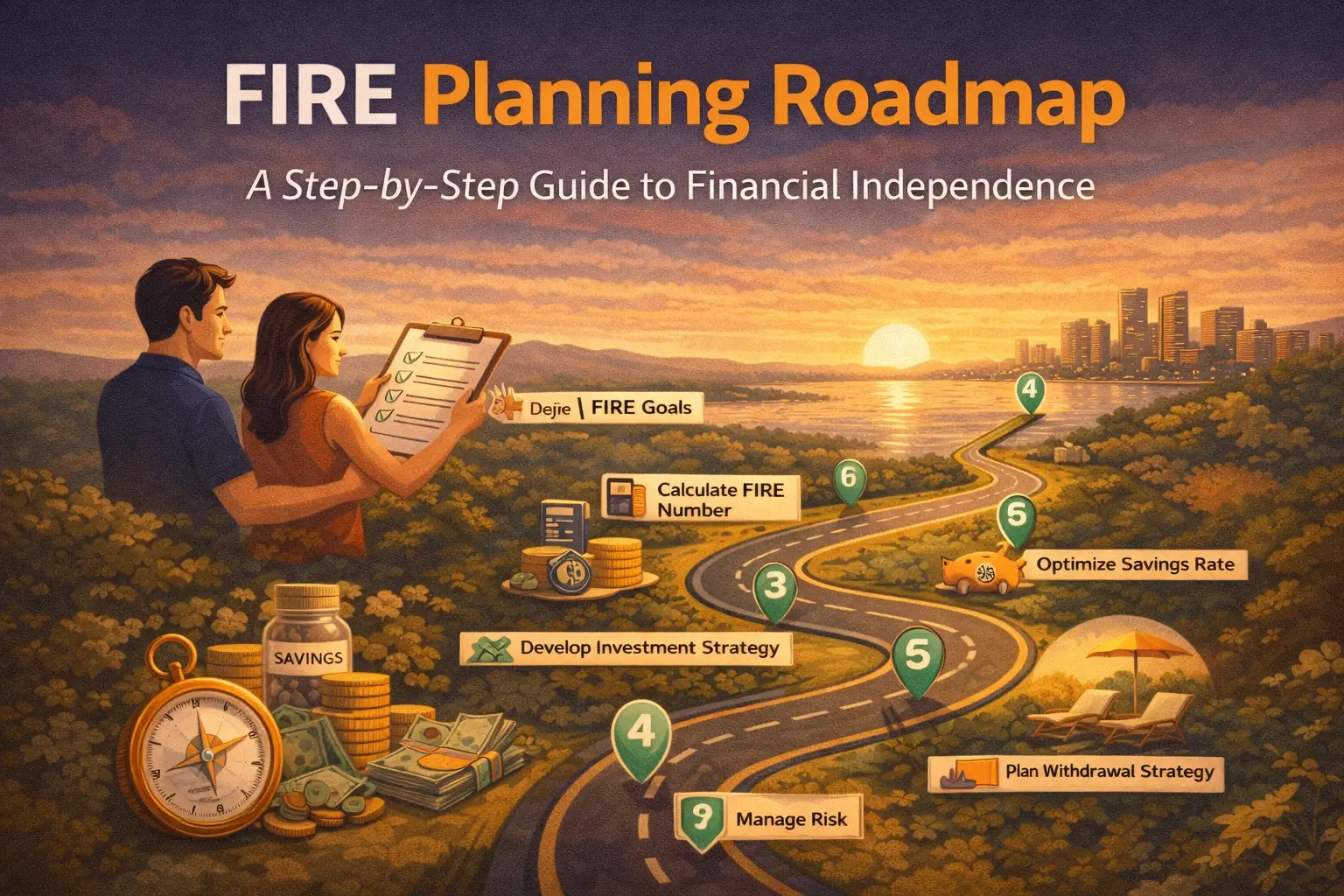
A real FIRE plan is a roadmap, a clear, step-by-step system that takes you from “this sounds cool” to “I’m actually doing this.”
In this guide, we’ll walk through exactly how to build that roadmap: what to focus on at each stage, how to avoid the mistakes that derail most people, and how to create a realistic timeline that actually works.
Let’s break it down.
Stage 1: Figure Out What Financial Independence Actually Means to You
Before you touch a calculator or open a spreadsheet, you need to answer one question:
What does financial independence mean to you?
Do you want to:
- Never work again and travel the world?
- Keep working but on your own terms?
- Maintain your current lifestyle without the stress?
- Live simply and get out of the rat race ASAP?
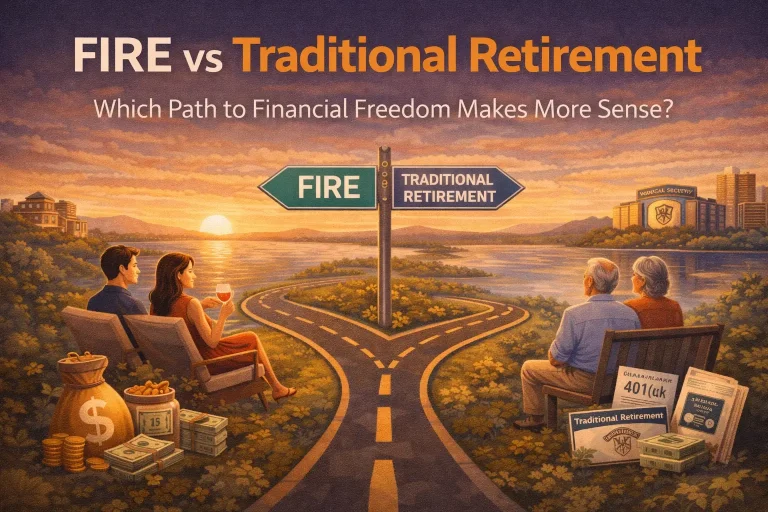
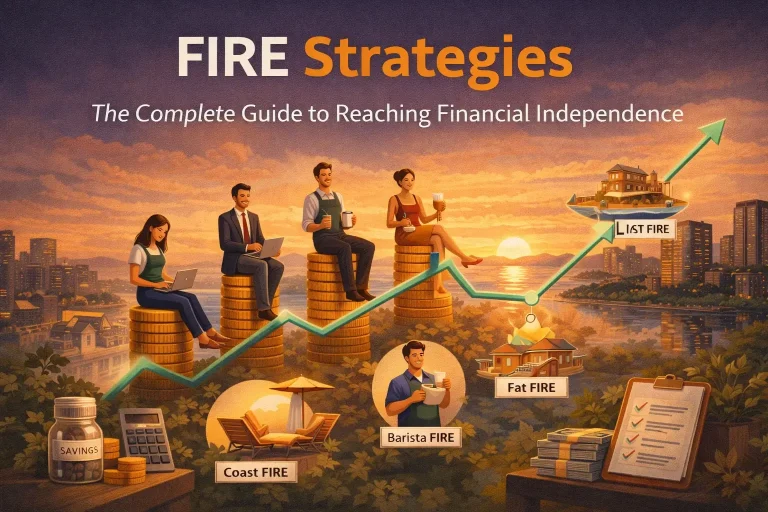
This matters because it determines which version of FIRE you’re chasing:
- Lean FIRE — retire quickly by living on very little
- Fat FIRE — retire comfortably without cutting back
- Barista FIRE — leave full-time work but keep some part-time income
- Coast FIRE — invest heavily now, then ease up and let it grow
Without clarity on this, you’ll just be randomly saving money with no real direction.
Stage 2: Track Your Actual Spending
You can’t plan FIRE if you don’t know how much you actually spend.
Not what you think you spend. What you actually spend.
Track everything for at least a few months:
- Housing (rent/mortgage, insurance, property taxes)
- Transportation (car payment, insurance, gas, maintenance)
- Food (groceries and eating out)
- Insurance (health, life, disability)
- Utilities (electric, water, internet, phone)
- Subscriptions (streaming, gym, apps)
- Travel and entertainment
- Taxes
Use a full year of data if you can. It avoids seasonal weirdness like holiday spending or summer vacations throwing off your average.
This number is your foundation. Everything else builds on this.
Stage 3: Calculate Your FIRE Number
Once you know your annual spending, calculating your FIRE number is straightforward.
Most people use the 4% rule, which came from the Trinity Study analyzing historical market returns.
The formula:
FIRE Number = Annual Expenses × 25
Example:
If you spend $50,000 per year
Your FIRE number is $1.25 million
That’s it. That’s how much you need invested.
But Here’s the Thing…
More conservative planners use a 3–3.5% withdrawal rate instead of 4% for extra safety, especially if retiring super early.
That would mean multiplying by 28–33 instead of 25.
Also, some people calculate healthcare costs separately since they’re such a wild card in the U.S.
Your FIRE number isn’t a guess. It’s a specific, calculated target.
Stage 4: Crank Up Your Savings Rate
Here’s what most people don’t realize: your savings rate matters way more than your investment returns — at least in the early years.
Check out how your timeline changes based on savings rate:
- 20% savings rate → ~30+ years to FIRE
- 40% savings rate → ~20 years to FIRE
- 60% savings rate → ~12–15 years to FIRE
The difference between 20% and 60% is literally retiring at 65 vs. 45.
Early on, focus on:
- Paying off high-interest debt (credit cards, personal loans). If you are experiencing financial difficulty, it may be worth researching bad credit personal loan options, comparing rates, fees and repayment terms and seeking financial advice before making any decisions.
- Increasing your income (raises, job switches, side hustles)
- Not letting your spending creep up as you earn more
Your savings rate is the engine that powers the whole thing.
Stage 5: Build a Smart Investment Strategy
Once you’re consistently saving, you need to invest that money efficiently.
Most FIRE folks keep it simple:
- Broad-market index funds (like S&P 500 or total stock market funds)
- Tax-advantaged accounts (401(k), IRA, HSA)
- Taxable brokerage accounts (for early retirement access)
- Maybe real estate (if that’s your thing)
A Typical Investment Order of Operations:
- Get your employer’s 401(k) match (free money)
- Max out your HSA if you have one
- Max out your Roth or Traditional IRA
- Keep maxing your 401(k)
- Invest extra in a taxable brokerage account
As your portfolio grows, tax strategy becomes increasingly important. Getting this right can save you tens of thousands over time.
Stage 6: Plan for the Risks
When you retire early, your money needs to last 40–50 years instead of the typical 25–30.
That changes everything.
Risks you need to plan for:
- Sequence of returns risk (market crashes right when you retire)
- Inflation slowly eating away your purchasing power
- Market volatility causing wild swings
- Tax law changes affecting your plans
How to protect yourself:
- Use a more conservative 3–3.5% withdrawal rate
- Keep 1–3 years of expenses in cash as a buffer
- Diversify your investments
- Be flexible about cutting spending during bad market years
Risk planning isn’t optional. It’s structural.
Stage 7: Keep Some Income Options Open
Here’s a mistake a lot of people make: they assume they’ll never earn another dollar after hitting their FIRE number.
That’s not realistic, and it’s not necessary.
Smart FIRE planners maintain flexibility:
- Keep freelance skills sharp
- Maintain consulting relationships
- Stay open to remote contract work
- Consider part-time options
Having the option to earn money, even if you don’t need to, dramatically reduces stress on your portfolio.
This is exactly why Barista FIRE and Coast FIRE are becoming so popular.
Stage 8: Figure Out Healthcare (Especially in the U.S.)
If you’re in the United States, healthcare is probably the scariest part of early retirement.
You need to plan for:
- ACA marketplace plans and what they’ll cost
- Maximizing your HSA while you’re working
- Whether you should live in a state with better healthcare options
- If part-time work for benefits makes sense
Healthcare planning alone can make or break whether early retirement is realistic for you.
Stage 9: Don’t Forget About Inflation
Inflation is sneaky. It compounds quietly in the background.
A $60,000 lifestyle today might require:
- ~$90,000 in 20 years
- ~$110,000+ in 25 years
And that’s assuming normal inflation. We’ve seen how wild it can get.
Also, “lifestyle drift” is real, people’s spending tends to creep up over time even without realizing it.
Successful FIRE planners:
- Recalculate their expenses every year or two
- Resist automatic lifestyle upgrades
- Stay clear on their long-term goals
Stage 10: Have a Withdrawal Plan
Hitting your FIRE number isn’t the finish line. You need a plan for actually using that money.
Common withdrawal strategies:
- Fixed 4% withdrawal (take out 4% of your starting balance, adjust for inflation)
- Variable percentage (adjust based on portfolio performance)
- Guardrail strategies (increase or decrease spending based on market conditions)
- Bucket strategies (keep short-term money in cash, long-term in stocks)
Flexibility improves your chances of success. Rigid systems can break.
Stage 11: Prepare Mentally (Yes, Really)
This might sound weird, but one of the most underestimated parts of FIRE is psychological preparation.
Questions to think about:
- What will you actually do all day?
- Where will your sense of purpose come from?
- How will you maintain friendships and community?
- What if you get bored?
Financial independence solves money problems. It doesn’t solve existential ones.
A lot of people hit FIRE and realize they have no idea what to do with themselves. Plan for that transition.
A Simple 5-Phase Timeline
To make this less overwhelming, think of FIRE planning in five phases:
Phase 1: Foundation (Years 0–3)
- Pay off debt
- Increase your income
- Build a solid emergency fund
Phase 2: Acceleration (Years 3–10)
- Max out tax-advantaged accounts
- Push your savings rate as high as sustainable
- Resist lifestyle inflation
Phase 3: Expansion (Years 10–20)
- Grow your taxable investments
- Optimize your tax strategy
- Reassess your risk tolerance
Phase 4: Transition (Right Before FIRE)
- Build a cash buffer
- Reduce fixed expenses where possible
- Test your retirement budget for a few months
Phase 5: Financial Independence
- Implement your withdrawal strategy
- Monitor your portfolio
- Adjust spending based on market conditions
Each phase has different priorities. Don’t try to do everything at once.
Common Mistakes That Derail FIRE Plans
- Underestimating healthcare costs (especially in the U.S.)
- Ignoring taxes when withdrawing money
- Assuming 10% returns forever (be conservative)
- Not accounting for inflation
- Setting completely unrealistic savings rates you can’t maintain
- Not planning for what you’ll actually do when you retire
Honestly? Avoiding mistakes matters more than optimizing returns.
How to Know If You’re On Track
You’re making real progress if:
- Your net worth grows consistently year over year
- Your savings rate stays stable (or increases)
- Your spending is intentional, not random
- Your investments are diversified
- You recalculate your target number at least once a year
FIRE planning isn’t “set it and forget it.” Annual check-ins are essential.
The Most Important Thing: Sustainability
Extreme savings rates work great… until they don’t.
Burning out and giving up is worse than saving less but doing it consistently for 20 years.
The ideal FIRE roadmap:
- Is aggressive but realistic for your life
- Aligns with your personality
- Can survive job changes or life surprises
- Accounts for uncertainty
Long-term consistency beats short-term intensity. Every single time.
Final Thoughts: FIRE Is a System, Not a Hack
FIRE isn’t about finding some magic loophole to retire early.
It’s about building a structured financial system that gives you options and freedom.
When you:
- Define your specific target
- Control your expenses intentionally
- Optimize your income
- Invest efficiently with taxes in mind
- Manage risks proactively
- Prepare psychologically
Financial independence stops being this vague dream and becomes predictable and achievable.
A clear roadmap eliminates confusion and overwhelm.
And that clarity is what turns FIRE from an internet trend into a real, executable life strategy.