How Hacking Housing Costs Can Shave Years Off Your Coast FIRE Timeline
Coast FIRE is a retirement strategy where you save aggressively early in your career, then stop contributing once your invested amount is large enough for compound growth to reach your retirement number on its own. Once you hit that number, you can stop aggressive saving and cover only your current expenses.
The math is straightforward, but the hard part is getting to that invested amount as fast as possible, and for most people in expensive cities, rent is the single largest obstacle. If you’re spending $2,500 or $3,000 a month on a solo apartment, that’s money that could be compounding in an index fund for the next twenty or thirty years.
Cutting your rent by $1,000 to $1,500 a month and investing the difference can shave years off your Coast FIRE timeline, and the effect is larger than most people expect.
How Rent Savings Compound Over a Coast FIRE Timeline
The power of Coast FIRE comes from time. Money invested early has decades to grow, which means every dollar you redirect from rent to investments in your twenties or early thirties carries outsized weight compared to the same dollar saved at forty.

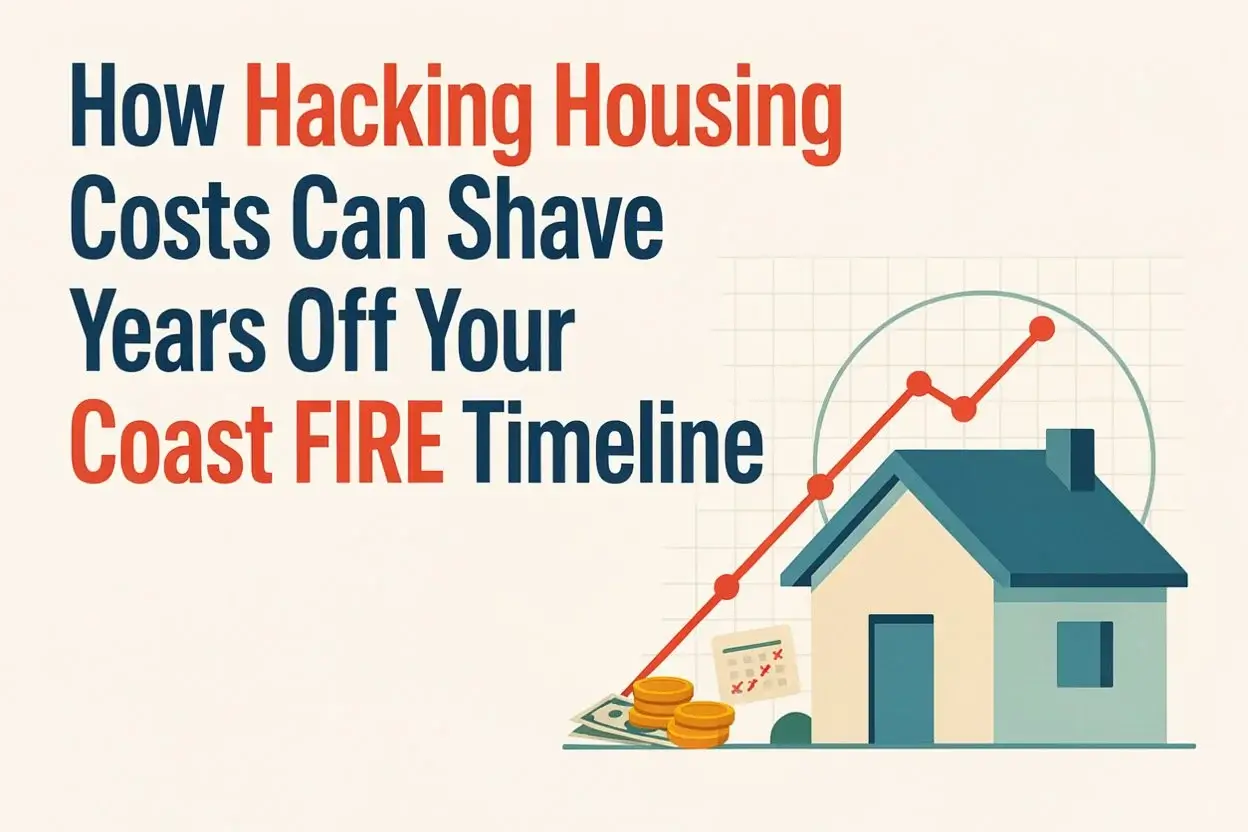
Consider a simple scenario. You’re 27, earning $85,000 in a city like New York, and you’re currently paying $2,800 a month for a studio apartment. If you move into a shared apartment and bring your rent down to $1,400, you’ve freed up $1,400 a month, or $16,800 a year, that you can invest. Assuming a 7% average annual return after inflation, that $16,800 per year invested over five years grows to roughly $97,000. Leave that $97,000 untouched for another twenty years at the same return rate, and it grows to approximately $375,000 without a single additional contribution.
That’s the Coast FIRE math in action. Five years of aggressive rent optimization during your late twenties can produce a six-figure portfolio that compounds on its own for the rest of your career. The same $16,800 per year saved starting at 37 instead of 27 would need to be invested for significantly longer to reach the same outcome, because you’ve lost ten years of compounding.
Split a Lease Instead of Renting Solo
The simplest way to cut rent in an expensive city is to share an apartment. In Manhattan, a one-bedroom apartment can run $3,500 to $4,500 a month depending on the neighborhood. A two-bedroom in the same area might cost $4,000 to $5,500. Split that two-bedroom with a roommate and your share drops to $2,000 to $2,750, saving you $1,000 to $1,500 a month compared to renting solo.
The financial logic is clear, but the execution depends on finding someone you can share a kitchen, bathroom, and living space with for a year or longer. If you end up with a roommate whose habits or finances don’t align with yours, you’ll deal with unexpected costs and daily friction that makes you abandon the arrangement after three months. That risk drops significantly when you can review a potential roommate’s schedule, budget, and living preferences before you agree to share a lease. Roommate search services such as SpareRoom let you do exactly that.
You can search for roommates in Manhattan, Boston, Chicago, or Los Angeles and filter results by neighborhood, budget, and move-in date. From there, you can check whether a potential roommate’s work hours, cleanliness standards, and guest preferences align with yours before scheduling a viewing. You can also see budget ranges upfront, which helps you avoid committing to a lease with someone who can’t afford their share of the rent.
Invest the Difference Immediately
Saving $1,400 a month on rent only accelerates your Coast FIRE timeline if you invest it consistently. If the money sits in a checking account, you’ll spend it on other things within a few months. Set up an automatic transfer to a brokerage account on the same day your rent is due so the savings move before you have a chance to redirect them.
Where you invest depends on your timeline and risk tolerance, but for most Coast FIRE planners, a low-cost total market index fund or a target-date retirement fund is a reasonable default. The goal at this stage is to get the money into the market early so it starts compounding. You can refine your allocation later once the habit is established and your balance grows.
If you’re already maxing out a 401(k) or IRA, the rent savings can go into a taxable brokerage account.
Negotiate Lease Terms That Protect Your Savings Plan
If you’re sharing an apartment to reduce costs, make sure the lease terms don’t create financial risk that cancels out your savings. Read the lease agreement carefully before signing and confirm how rent is structured. In some shared leases, each tenant is individually responsible for their portion. In others, all tenants are jointly liable for the full amount, which means if your roommate stops paying, you owe the entire rent.
Ask the landlord or management company which structure applies. If the lease is joint and several, discuss with your roommate what happens if one of you needs to leave early. A written agreement between roommates covering rent responsibility, move-out notice periods, and how to handle utility bills can prevent a surprise expense from wiping out months of investment gains.
You should also factor in the lease renewal cycle. If your landlord raises rent significantly at renewal, the amount you can redirect to investments each month shrinks, which slows your progress toward your Coast FIRE number. Keep a buffer in your budget for a 3% to 5% annual rent increase, and revisit your Coast FIRE projections each year to make sure your invested amount still tracks toward your target.
Final Thoughts
Housing is the biggest controllable expense for most Coast FIRE planners, and cutting it aggressively during your highest-compounding years has an outsized effect on your timeline. Run the numbers. If splitting a lease for even three to five years frees up $1,000 or more a month, and you invest that consistently, those early contributions will have decades to compound before you reach retirement age.