What Is Lean FIRE? Your Guide to Financial Independence on a Minimalist Budget
Lean FIRE gets a bad rap.
Some people think it means eating ramen noodles forever and never going out. Others assume it’s impossible unless you live in a van or move to Thailand.
Both are wrong.
Lean FIRE is simply reaching financial independence with lower living expenses — which means you need less money saved to retire early. That’s it.
If you can be happy spending less, you can potentially retire years or even decades earlier than someone chasing a more expensive lifestyle.
Let’s dig into what Lean FIRE actually looks like, how the math works, and whether it’s realistic for you, especially if you’re pursuing Lean FIRE in the United States.
What Exactly Is Lean FIRE?
Lean FIRE stands for Lean Financial Independence, Retire Early.
The concept: reach financial independence while keeping your annual living expenses low — typically somewhere between:
- $25,000–$40,000 per year for a single person
- $35,000–$55,000 per year for a couple
Now, before you say “that’s impossible,” remember that these numbers look wildly different depending on where you live. $35,000 goes a lot further in rural Kansas than it does in Brooklyn.
The core principle is simple:
Lower expenses → Smaller nest egg needed → Earlier retirement
Lean FIRE isn’t about deprivation. It’s a deliberate early retirement strategy built around minimizing fixed costs and maximizing freedom.
The Math Behind Lean FIRE
Lean FIRE uses the same foundation as the broader FIRE movement: the 4% rule.
This rule comes from what’s commonly referred to as The Trinity Study, a research project conducted by finance professors at Trinity University. It analyzed historical U.S. stock and bond returns dating back to 1926 and found that withdrawing 4% annually from a diversified portfolio had a high probability of lasting at least 30 years.
That research heavily influenced the modern financial independence movement.
The Formula
Lean FIRE Number = Annual Expenses × 25
Why multiply by 25? Because:
1 ÷ 0.04 = 25
Real Examples
If you spend $30,000 per year:
$30,000 × 25 = $750,000 needed
If you spend $40,000 per year:
$40,000 × 25 = $1,000,000 needed
Compare that to someone spending $80,000 per year who’d need $2 million. Same retirement lifestyle in terms of freedom and time, half the money required.
That’s the power of Lean FIRE.
What About Inflation?
The 4% rule already assumes inflation-adjusted withdrawals.
In other words, if you withdraw $30,000 in year one and inflation is 3%, you would increase your withdrawal to $30,900 in year two to maintain purchasing power.
The original research accounted for historical inflation patterns, which is why portfolio allocation and long-term growth matter so much in any financial independence strategy.
Want to Calculate Your Exact Number?
Instead of rough estimates or napkin math, run your actual numbers using free Lean FIRE calculator online.
You can adjust:
- Your current age and savings
- Expected investment returns
- Timeline to retirement
Seeing real projections makes Lean FIRE feel concrete instead of theoretical.
What Does a Lean FIRE Lifestyle Actually Look Like?
Here’s what people get wrong: Lean FIRE isn’t poverty. It’s intentional spending.
Most Lean FIRE folks:
- Own a modest, paid-off home (or rent affordably)
- Drive one reliable car (or none if they live somewhere walkable)
- Cook at home most of the time
- Skip luxury brands and lifestyle creep
- Spend money on what genuinely matters to them
What they prioritize instead:
- Time to do what they want
- Freedom to live anywhere
- Less financial stress
- Ability to pursue passion projects or part-time work they actually enjoy
It’s not about deprivation, it’s about knowing what you value and cutting what you don’t.
How Lean FIRE Compares to Other FIRE Flavors
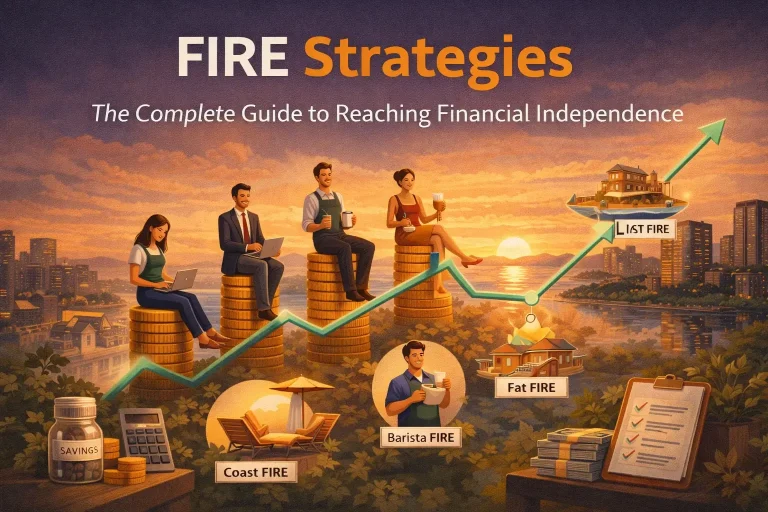
Lean FIRE vs. Coast FIRE
Lean FIRE: You stop working entirely because your investments cover all your expenses.
Coast FIRE: Your investments will grow enough to fund retirement later, but you still work to cover current living costs.
Think of Coast FIRE as “FIRE in progress.” You’ve frontloaded your savings, and now you can ease off the gas pedal.
(You can calculate your Coast FIRE number at coastfirecalc.com too.)
Lean FIRE vs. Fat FIRE
Lean FIRE:
- $30k–$50k annual spending
- Smaller portfolio ($750k–$1.25M)
- Faster timeline
Fat FIRE:
- $80k–$150k+ annual spending
- Larger portfolio ($2M–$4M+)
- Longer accumulation phase
Fat FIRE is about maintaining a comfortable lifestyle. Lean FIRE is about maximizing freedom while minimizing expenses.
Lean FIRE vs. Traditional Retirement
Traditional retirement:
- Work until 60–65
- Heavy reliance on Social Security and pensions
- Limited control over timeline
Lean FIRE:
- Retire in your 30s or 40s (sometimes even earlier)
- Your investments fund your lifestyle
- Social Security becomes a nice bonus later
According to Fidelity Investments, many American households approaching retirement have saved far less than what’s needed for a traditional 20–30 year retirement. That gap is one reason alternative financial independence strategies like Lean FIRE have gained popularity in the United States.
One path isn’t inherently better, it depends entirely on what you value.
The Stuff They Don’t Tell You About Lean FIRE
Most beginner articles stop at the basics. Let’s talk about what actually matters when you’re living it.
1. Healthcare Is the Big Question (If You’re in the U.S.)
If you retire before 65, you’re not eligible for Medicare yet. So you’ll need:
- ACA marketplace plans (often heavily subsidized)
- Smart income management to maximize subsidies
- Possibly an HSA strategy
Here’s the interesting part: Lean FIRE can actually work better for healthcare than Fat FIRE because your taxable income is lower, which can mean larger ACA premium subsidies.
Many Lean FIRE retirees also perform strategic Roth conversions during low-income years to reduce lifetime tax burden.
2. Sequence of Returns Risk
This is a technical term for “what if the market crashes right when I retire?”
If you retire and immediately face a prolonged bear market while withdrawing money, your portfolio may shrink faster than expected, even if markets eventually recover.
How Lean FIRE households manage this risk:
- Keep 1–2 years of expenses in cash
- Use a more conservative 3.5% withdrawal rate
- Stay flexible with spending during downturns
- Generate occasional side income if necessary
Lower fixed expenses create more flexibility, which is one of Lean FIRE’s biggest advantages.
3. Geographic Arbitrage
One of the most powerful levers for Lean FIRE in the United States is simply where you live.
Many Lean FIRE retirees:
- Move to lower-cost states
- Downsize housing dramatically
- Relocate internationally to reduce cost of living
Living in San Francisco on $35,000 per year? Extremely difficult. Living in Knoxville, Tulsa, or even parts of the Midwest on that budget? Much more realistic.
Location choice alone can shave years off your early retirement timeline.
How Fast Can You Actually Reach Lean FIRE?
Let’s look at a realistic example:
Income: $90,000/year
Savings rate: 50%
Investing in: Low-cost index funds
Average return: 7% annually
With disciplined saving and investing, Lean FIRE could be achievable in roughly 12–18 years.
Your timeline depends on:
- Savings rate
- Market returns
- Lifestyle inflation control
The higher your savings rate, the faster financial independence becomes achievable. That’s the real driver behind any successful early retirement strategy.
The Pros and Cons of Lean FIRE
The Upsides
- Freedom arrives faster
- Less financial stress
- More flexibility with your time
- Reduced exposure to consumerism
The Challenges
- Tighter budget leaves less room for error
- Market volatility feels more intense
- Healthcare complexity before Medicare
- Requires consistent discipline
Lean FIRE is powerful, but it requires intentional execution.
Is Lean FIRE Realistic in the U.S.?
Short answer: Yes, but context matters.
Lean FIRE is significantly more achievable if you:
- Live in a low- to mid-cost-of-living area
- Maintain low housing costs
- Minimize debt
- Keep healthcare planning realistic
In high-cost cities like NYC or San Francisco, Lean FIRE is harder unless relocation is part of the plan.
Family size also plays a major role. Lean FIRE for a single person is very different than for a family of four.
Who Is Lean FIRE Best For?
Lean FIRE works well for people who:
- Value time over material possessions
- Genuinely enjoy simple living
- Are disciplined with budgeting and investing
- Prefer experiences over status spending
It may not be ideal for those who:
- Prefer luxury and high-consumption lifestyles
- Struggle with financial planning
- Have unpredictable or structurally high expenses
Final Thoughts: Is Lean FIRE Worth It?
Lean FIRE isn’t about living miserably on nothing.
It’s about:
- Spending intentionally
- Saving aggressively
- Investing consistently
- Purchasing freedom earlier than traditional retirement allows
If you can be content without a high-expense lifestyle, financial independence becomes dramatically more attainable.
Before deciding whether Lean FIRE fits your goals, run your real numbers.
Use a structured Lean FIRE calculator like the one at coastfirecalc.com to model your actual timeline and investment growth.
When you see concrete projections, this stops being a philosophy, and starts becoming an executable plan.