Portfolio Strategy: How to Build a Smart Investment Plan for Financial Independence
If understanding the stock market is like learning how an engine works, then portfolio strategy is about designing the entire vehicle.
Anyone can throw money into a brokerage account and buy some stocks. But building a structured, tax-efficient, well-balanced portfolio that actually gets you to financial independence?
That’s where the real wealth-building happens.
For Americans pursuing FIRE — or even just trying to retire comfortably — your portfolio strategy determines:
- How fast you reach financial independence
- How well your plan survives market downturns
- How sustainable your withdrawals will be in retirement
This guide will walk you through everything from beginner fundamentals to advanced strategies, with a specific focus on U.S. taxes, retirement accounts, and what actually works for long-term wealth building.
What Is a Portfolio Strategy, Really?
A portfolio strategy is basically your investment game plan. It’s a structured approach for:
- Allocating your money across different assets (stocks, bonds, cash, etc.)
- Managing risk so you can sleep at night
- Optimizing taxes so you keep more of what you earn
- Aligning everything with your long-term goals
It answers four critical questions:
- How much risk should I take?
- What assets should I own?
- Where should I hold them? (401(k), Roth IRA, regular brokerage account?)
- How do I adjust over time?
Without a defined strategy, investing is just reacting to whatever’s happening in the news.
With a strategy, it becomes systematic and way less stressful.
The Foundation: Asset Allocation
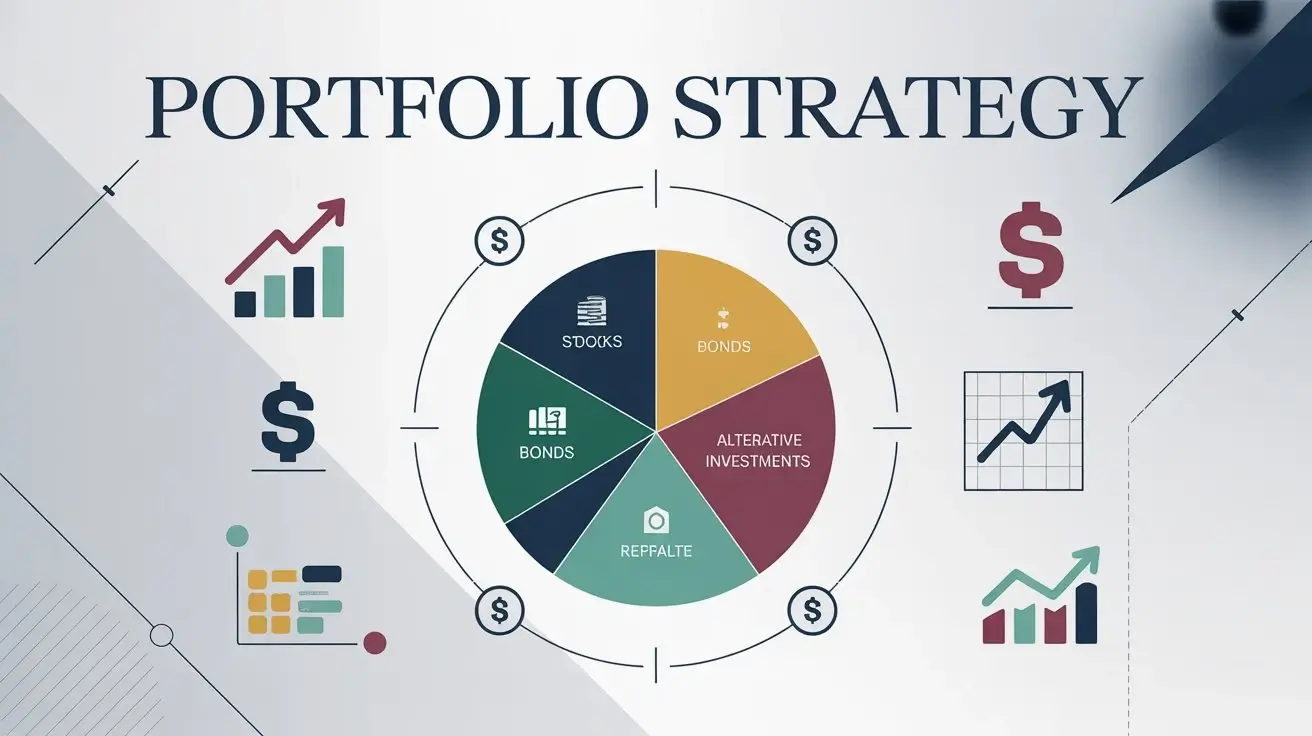
Asset allocation is just a fancy term for how you split your money between major investment types, typically:
- U.S. stocks
- International stocks
- Bonds
- Cash
Here’s something important: research consistently shows that asset allocation explains more of your portfolio’s performance than picking individual stocks.
In other words, what you invest in matters more than which specific stocks you choose.
Example Allocations
Aggressive (for young FIRE pursuers with long timelines):
90% stocks / 10% bonds
Balanced (moderate approach):
70% stocks / 30% bonds
Conservative (closer to retirement):
50% stocks / 50% bonds
If you’re pursuing Coast FIRE or planning to retire early, higher stock allocations are pretty common during your accumulation years because you have time to ride out the volatility.
Diversification: The Only Free Lunch in Investing
You’ve probably heard this term a million times, but here’s what it actually means:
Diversification reduces risk without necessarily lowering your expected returns.
Instead of betting everything on a handful of stocks, most smart investors use broad index funds like:
- S&P 500 (500 largest U.S. companies)
- Total Stock Market Index (basically the entire U.S. market)
Broad exposure gives you:
- Participation in overall economic growth
- Protection from single-company disasters
- Smoother, less volatile returns over time
For beginners, total market index funds inside a 401(k) or Roth IRA are often the smartest, simplest starting point.
Risk Tolerance vs. Risk Capacity (They’re Different!)
A lot of people confuse these two:
Risk Tolerance
How much volatility you can emotionally handle without freaking out and selling everything.
Risk Capacity
How much risk your financial situation actually allows.
Example:
A 28-year-old pursuing Lean FIRE with a stable job and no dependents? High risk capacity. They have decades to recover from market crashes.
A 55-year-old planning to retire in five years? Lower risk capacity — even if they feel comfortable with risk.
Your portfolio strategy needs to reflect both of these.
Here’s the problem: behavioral finance research shows that people overestimate their risk tolerance during bull markets and drastically underestimate it during crashes.
Everyone’s brave when stocks are going up 20% a year. Then the market drops 30%, and suddenly they’re panic-selling at the bottom.
Don’t be that person.
Account Location Strategy (Tax Efficiency Matters More Than You Think)
Portfolio strategy isn’t just about what you invest in — it’s about where you hold those investments.
This is called “asset location,” and it can save you thousands of dollars over time.
Tax-Advantaged Accounts (The Good Stuff)
- 401(k)
- Traditional IRA
- Roth IRA
- HSA (Health Savings Account)
Benefits:
- Tax-deferred or completely tax-free growth
- No annual capital gains taxes
- Dividends compound without getting taxed every year
Taxable Brokerage Accounts
- You pay capital gains taxes when you sell
- Dividends get taxed annually
Smart Asset Location Strategy
Advanced investors optimize by:
- Holding bonds in tax-deferred accounts (they throw off taxable interest)
- Keeping tax-efficient index funds in taxable accounts
- Using Roth accounts for high-growth assets (so all that growth is tax-free forever)
This improves your after-tax returns without changing your risk level at all.
Rebalancing: Staying on Track
Over time, markets don’t move in sync. Stocks might surge while bonds stay flat.
If you started with a 70% stocks / 30% bonds portfolio, it might quietly become 85% stocks / 15% bonds after a few good years.
That’s more risk than you planned for.
Rebalancing means periodically adjusting back to your target allocation.
Common Approaches:
- Calendar-based: Rebalance once a year
- Threshold-based: Rebalance when your allocation drifts more than 5%
Rebalancing forces you to sell high and buy low systematically — which is exactly what you should be doing but is psychologically hard.
For FIRE investors, disciplined rebalancing also reduces “sequence-of-returns risk” later in retirement.
Portfolio Strategies for Different FIRE Stages
Your strategy should change as you move through different phases of your journey.
1. Accumulation Phase (Building Wealth)
Goal: Maximum compounding and growth
Typical characteristics:
- High stock allocation (80–100%)
- Automatic contributions every month
- Minimal cash sitting around doing nothing
- Low-cost index funds
2. Coast FIRE Strategy
Once you’ve hit your Coast FIRE number:
- Maintain growth allocation (still mostly stocks)
- Reduce or stop contributions if you want
- Gradually start thinking about downside protection
3. Early Retirement (Withdrawal Phase)
This is where risk changes dramatically.
Sequence-of-returns risk becomes your biggest concern — if the market crashes right when you start withdrawing money, it can permanently damage your portfolio’s sustainability.
Common strategies to protect against this:
- Bond tents (higher bond allocation right before and after retirement)
- Glide paths (gradually reducing stock allocation)
- Bucket strategy (keep 1–3 years in cash, 5–10 years in bonds, rest in stocks)
Advanced Portfolio Concepts (Once You’ve Mastered the Basics)
Once you’re comfortable with the fundamentals, here are some deeper strategies worth understanding:
1. U.S. vs. International Allocation
A lot of American investors put everything in U.S. stocks.
That’s actually risky — you’re betting your entire financial future on one country’s economy.
A globally diversified portfolio reduces that concentration risk.
Common global split:
- 60% U.S. stocks
- 40% International stocks
This roughly matches global market weights.
2. Factor Tilting
Some investors “tilt” toward specific factors that have historically shown higher returns:
- Small-cap stocks (smaller companies)
- Value stocks (undervalued companies)
These factors have delivered higher long-term returns historically — but with more volatility along the way.
3. Tax-Loss Harvesting
In taxable accounts, you can strategically:
- Sell investments that are down (at a loss)
- Use those losses to offset capital gains
- Reduce your taxable income
Over decades, this can significantly improve your after-tax returns.
Portfolio Strategy Mistakes to Avoid
Let’s talk about what not to do:
- Chasing hot sectors (tech stocks are up 50%? Better go all-in! …wrong.)
- Overcomplicating your allocation (you don’t need 47 different funds)
- Ignoring fees (high fees silently destroy wealth)
- Emotional market timing (selling low, buying high)
- Holding too much cash long-term (inflation slowly destroys it)
Here’s the thing about cash: it feels “safe,” but inflation is an invisible tax. A portfolio sitting in cash that’s “not losing money” is actually losing purchasing power every year.
How Portfolio Strategy Supports Financial Independence
Your portfolio strategy needs to align with your specific goals:
- Your target FIRE number
- Expected withdrawal rate (4%, 3.5%, etc.)
- Your timeline to FI
- Your lifestyle flexibility
For example:
If you’re pursuing Fat FIRE, you’ll have a larger portfolio, so you might be able to handle more volatility.
If you’re pursuing Lean FIRE, withdrawal precision becomes more critical because you have less margin for error.
A Practical Framework (From Beginner to Advanced)
Stage 1 – Beginner (Just Starting Out)
- 90% Total U.S. Stock Market Index
- 10% Total Bond Market Index
- Invest inside 401(k) and Roth IRA
- Keep it simple
Stage 2 – Intermediate (Building Confidence)
- Add international stock exposure
- Start optimizing asset location across accounts
- Implement annual rebalancing
Stage 3 – Advanced (Maximizing Efficiency)
- Use tax-loss harvesting in taxable accounts
- Consider factor tilts if appropriate
- Model different withdrawal strategies
- Plan for sequence-of-returns risk mitigation
This layered approach lets you increase sophistication over time without getting overwhelmed at the beginning.
Final Thoughts
A portfolio strategy isn’t about predicting the market or finding the next hot stock.
It’s about:
- Structure (having a plan)
- Discipline (sticking to it)
- Tax efficiency (keeping more of what you earn)
- Risk alignment (matching your investments to your goals)
- Long-term clarity (knowing exactly what you’re doing and why)
For Americans pursuing financial independence, portfolio strategy is the bridge between earning money and building durable wealth.
It transforms investing from random participation into intentional design.
And over decades, that design compounds just as powerfully as the market itself.