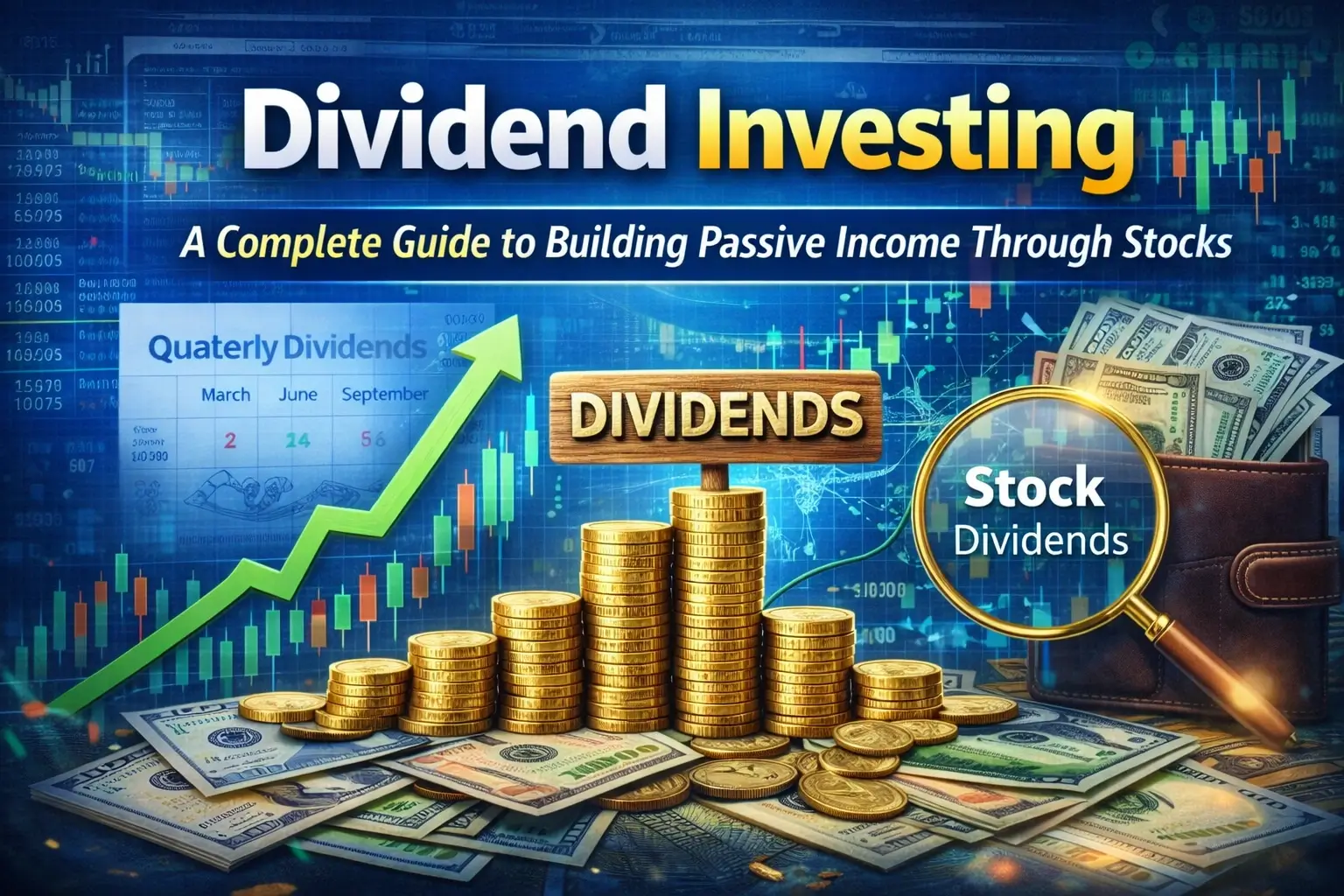
Dividend Investing Your Guide to Building Passive Income Through Stocks
There’s something deeply satisfying about getting paid just for owning a stock.
No selling required. No timing the market. Just regular cash payments landing in your account, quarter after quarter, year after year.
That’s dividend investing in a nutshell — and it’s one of the most reliable wealth-building strategies in the stock market.
Whether you’re planning for retirement, building long-term wealth, or just want some stability in a volatile market, dividend investing offers something powerful: you get paid while you wait for your investments to grow.
This guide will walk you through everything from the absolute basics to more sophisticated strategies that experienced investors use.
What Is Dividend Investing?
A dividend is simply a cash payment that a company sends to its shareholders, usually every three months (quarterly).
Not all companies pay dividends. High-growth companies like Tesla or Amazon typically reinvest every dollar back into expanding their business. But more mature, profitable companies like Coca-Cola or Johnson & Johnson share their earnings with investors.
Dividend investing means building a portfolio of these dividend-paying companies to:
- Generate regular income
- Reinvest those dividends for compounding growth
- Reduce overall portfolio swings
- Build long-term wealth
Think of it like owning rental property, but instead of collecting rent checks, you’re collecting dividend checks — and you don’t have to fix any toilets.
Why Do Companies Pay Dividends?
Companies usually pay dividends when:
- They’re generating stable, consistent profits
- They don’t have a ton of high-growth opportunities to reinvest in
- They want to attract income-focused investors
- They want to signal financial strength to the market
You’ll often find dividend-paying companies in sectors like:
- Utilities (electric companies, water companies)
- Consumer staples (toothpaste, cereal, household goods)
- Healthcare (pharmaceuticals, medical devices)
- Telecommunications (phone and internet providers)
- Financial services (banks, insurance companies)
These sectors tend to be more stable and predictable than flashy tech companies — and that’s exactly the point.
Key Dividend Metrics You Need to Understand
Before you start buying dividend stocks, you need to speak the language. Here are the important numbers:
Dividend Yield
This shows how much income you get relative to the stock price.
Formula:
Dividend Yield = Annual Dividend ÷ Share Price
Example:
If a stock pays $4 per year in dividends and trades at $100, the yield is 4%.
Higher yields might seem better, but be careful — an extremely high yield can be a red flag that the company is struggling and the stock price has crashed.
Dividend Payout Ratio
This measures how much of a company’s earnings are paid out as dividends.
Payout Ratio = Dividends ÷ Net Income
What to look for:
- Below 60% → Generally very sustainable
- 60–80% → Acceptable for stable industries
- Above 80% → Potentially risky
If a company is paying out almost all its profits, it might struggle to maintain the dividend during tough times.
Dividend Growth Rate
Here’s a secret: a growing dividend is often more powerful than a high starting yield.
Companies that consistently increase their dividends show:
- Earnings are growing
- Cash flow is strong
- Management cares about shareholders
Plus, dividend growth protects you from inflation and fuels long-term compounding.
Types of Dividend Stocks (Which One Is Right for You?)
Not all dividend strategies are created equal. Here are the main types:
1. High-Yield Dividend Stocks
These offer above-average yields (think 5%+) and provide immediate income.
Best for:
- Income-focused investors
- People nearing or in retirement
Risk:
- Higher chance of dividend cuts during recessions
- Stock price might not grow much
2. Dividend Growth Stocks
These companies steadily increase their dividends over time, even if the starting yield is modest.
Best for:
- Long-term investors
- Wealth builders
- Younger investors who can reinvest
Benefit:
- Strong total return potential
- Protection against inflation
- Compounding accelerates over time
3. Dividend Aristocrats
These are elite companies that have increased their dividends for 25+ consecutive years.
Characteristics:
- Incredible financial discipline
- Durable competitive advantages
- Stable earnings through recessions
Examples include companies like Procter & Gamble, Johnson & Johnson, and Coca-Cola.
These are often considered rock-solid core holdings.
The Power of Dividend Reinvestment (This Is Where the Magic Happens)
Dividend investing becomes significantly more powerful when you reinvest those dividends instead of spending them.
Here’s what happens when you reinvest:
- You automatically buy more shares
- Those new shares generate more dividends
- Those dividends buy even more shares
- The cycle continues, compounding over decades
Over long periods, reinvested dividends can account for 30-40% or more of total stock market returns.
It’s like a snowball rolling downhill — it starts small but gets massive over time.
Dividend Investing vs. Growth Investing
These represent two different philosophies:
Dividend Investing focuses on:
- Regular income
- Stability
- Predictable cash flow
- Mature, profitable companies
Growth Investing focuses on:
- Capital appreciation (stock price growth)
- Business expansion
- Higher volatility
- Younger, high-potential companies
Here’s the thing: you don’t have to choose just one. Many successful investors combine both strategies to balance income and growth.
Tax Considerations (Keep More of What You Earn)
Dividends get taxed differently depending on where you live and what type of account you hold them in.
General principles:
- Qualified dividends are often taxed at lower rates
- Non-qualified dividends may be taxed as regular income
- Tax-advantaged accounts (like retirement accounts) let dividends grow without annual taxes
This is one reason why holding dividend stocks in retirement accounts can be smart — you avoid the annual tax hit and let everything compound.
Always check your local tax rules or talk to a tax professional about your specific situation.
Risks of Dividend Investing (Yes, There Are Some)
Dividend investing isn’t risk-free. Here’s what can go wrong:
1. Dividend Cuts
Companies can reduce or eliminate dividends during tough times. It happens, and it hurts.
2. Value Traps
Sometimes a stock has a high yield simply because the stock price has crashed due to real problems. That’s not a bargain — it’s a trap.
3. Interest Rate Sensitivity
When interest rates rise, bonds become more attractive, and dividend stocks often fall in price as investors shift money around.
4. Sector Concentration
Income-focused portfolios can become too concentrated in defensive sectors like utilities and consumer staples, missing out on growth elsewhere.
The solution? Proper diversification.
How to Build a Dividend Portfolio
A well-constructed dividend portfolio typically includes:
- Multiple sectors (don’t put all eggs in one basket)
- A mix of yields and growth rates (balance income now with growth later)
- Strong balance sheets (companies with manageable debt)
- Consistent earnings history (proven track records)
You can build this using:
- Individual stocks (if you want control and enjoy research)
- Dividend-focused ETFs (instant diversification)
- Dividend index funds (simple, low-cost)
For beginners, diversified dividend ETFs offer simplicity and reduced risk compared to picking individual stocks yourself.
Advanced Strategies (Once You’ve Got the Basics Down)
Yield on Cost
Over time, if you hold a stock and the dividend grows, your effective yield on your original investment increases.
Example:
You buy a stock at $50 with a 4% yield ($2/year). Ten years later, the dividend has doubled to $4/year. Your yield on your original $50 investment is now 8% — even though the current market yield might still be 4%.
That’s the power of dividend growth.
Total Return Perspective
Don’t just focus on the dividend. The best dividend stocks also grow in price.
Strong dividend strategies generate:
- Dividend income
- Stock price appreciation
- Compounded total returns
The combination is what builds real wealth.
Dividend Safety Analysis
Experienced investors dig deeper and evaluate:
- Free cash flow (can they actually afford the dividend?)
- Debt levels (too much debt is dangerous)
- Earnings consistency (bumpy earnings = risky dividends)
- Industry stability (some industries are more reliable)
- Competitive advantages (economic moats protect profits)
Dividend sustainability matters more than dividend size.
The Psychology of Dividend Investing
There’s a behavioral advantage to dividends that doesn’t get talked about enough:
- Regular income reduces panic during market crashes
- You feel rewarded even when stock prices are volatile
- Income streams encourage long-term holding (less temptation to sell)
But there’s a trap too: chasing high yields because they look good can lead to terrible decisions.
Always prioritize quality and sustainability over flashy numbers.
Is Dividend Investing Right for You?
Dividend investing might be a great fit if:
- You want passive income
- You prefer stability over wild swings
- You’re focused on long-term compounding
- You value predictable cash flow
It might be less ideal if:
- You’re seeking aggressive short-term gains
- You want maximum exposure to high-growth tech
That said, many smart investors use dividend stocks as a core part of a balanced portfolio alongside growth investments.
Final Thoughts: Dividends as a Wealth-Building Engine
Dividend investing isn’t just about collecting quarterly checks.
It’s about owning high-quality, profitable businesses that reward shareholders consistently — year after year, through good times and bad.
When done right — focusing on quality, sustainability, growth, and diversification — dividend investing can:
- Generate reliable income
- Reduce portfolio volatility
- Accelerate long-term compounding
- Give you financial flexibility
The key is simple: prioritize dividend quality over yield, sustainability over hype, and long-term strategy over short-term income.
Do that, and dividends can become one of the most powerful tools in your wealth-building arsenal.