
The Top Mistakes People Make When Planning for Coast FIRE (And How to Avoid Them)
Introduction: The Allure and the Trap of Coast FIRE
Imagine a world where you don’t have to save another penny for retirement after the age of 30 or 35. You still work, but only enough to cover your rent, groceries, and weekend trips. Meanwhile, your nest egg—which you aggressively built in your 20s—sits in the background, quietly compounding into millions by the time you turn 65.
This is the promise of Coast FIRE (Financial Independence, Retire Early). It is arguably the most psychologically attainable version of the FIRE movement because it doesn’t require you to quit working entirely; it just asks you to stop stressing about the future.
But as with any financial strategy that looks perfect on a spreadsheet, real life has a way of complicating things. After analyzing hundreds of threads from the Coast FIRE community and consulting financial independence experts, it’s clear that the math is often the easy part. The psychology, the variables of life, and the “unknown unknowns” are where people stumble.
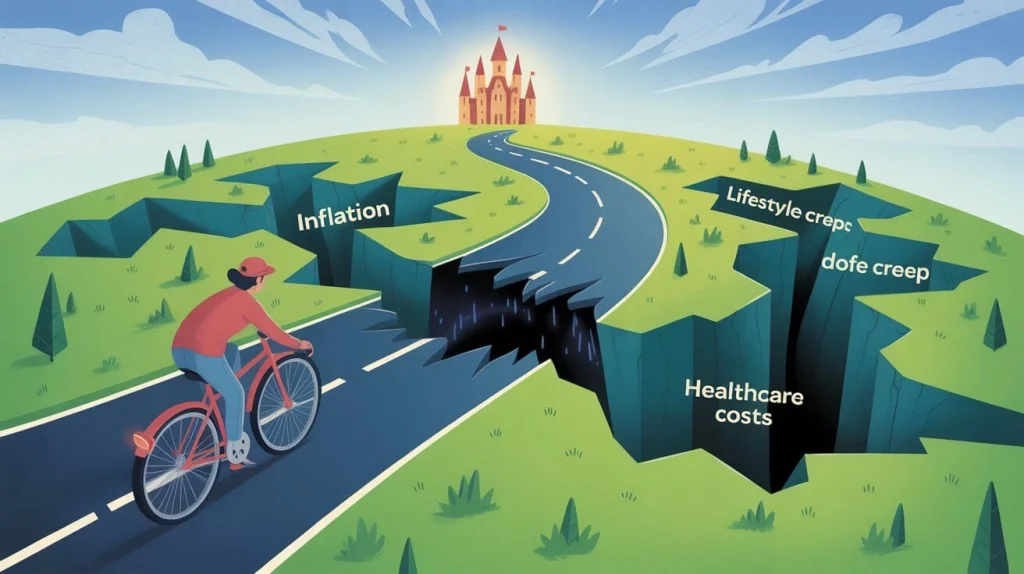
If you are calculating your “Coast number” on coastfirecalc.com, you are already ahead of the curve. But to ensure you actually cross the finish line, you need to navigate these common mistakes.
Mistake #1: treating “Coast” as a Full Stop
One of the most dangerous misconceptions is thinking that hitting your Coast number means you should stop saving entirely.
The Reality: Life is not linear. When you stop contributing to your investments at age 32 because a calculator said you’re “done,” you lose your margin of safety. If the market experiences a “lost decade” (a prolonged period of flat returns) immediately after you stop contributing, your compound interest engine stalls.
The Fix: Instead of stopping cold turkey, shift to a “Coast-Plus” approach. Continue contributing a small, manageable amount—even just $100 or $200 a month. This keeps the habit alive and acts as an insurance policy against poor market performance.
Mistake #2: Underestimating “Lifestyle Creep” (Inflation’s Silent Cousin)
Most people calculate their Coast FIRE number based on their current expenses.
- “I spend $40,000 a year now, so I’ll need $40,000 a year (inflation-adjusted) in retirement.”
The Reality: The life you live at 25 is vastly different from the one you live at 45 or 55. You might be happy sharing an apartment and eating ramen now, but in two decades, you may want a single-family home, better healthcare, or the ability to help your kids with college tuition. If you lock in a “lean” lifestyle number too early, you trap your future self in a budget that no longer fits.
The Fix: Pad your expense assumptions. If you currently live on $40,000, run your Coast FIRE calculations assuming you’ll need $50,000 or $60,000 in today’s dollars. It’s better to overshoot and have extra cash than to undershoot and be forced back into the corporate grind at age 50.
Mistake #3: Neglecting the “Boring Middle” Liquidity
Coast FIRE focuses heavily on two points: Point A (Today) and Point B (Age 65). It often ignores the 30 years in between.
The Reality: Since Coast FIRE relies on locking money away in tax-advantaged accounts (like 401ks and IRAs) to grow for decades, that money is often illiquid. If you have a mid-life crisis, a health emergency, or an opportunity to buy a dream home at age 40, you might be “retirement rich” but “cash poor.”
The Fix: Ensure you are building a taxable brokerage bridge or a robust emergency fund alongside your retirement accounts. You need accessible liquid cash to handle life’s mid-game hurdles without incurring early withdrawal penalties.
Mistake #4: Ignoring the Psychological Shift (Identity Crisis)
This is rarely discussed but is frequently cited as a major regret on forums like Reddit’s r/coastFIRE.

The Reality: For years, your identity has been “The Saver.” You optimized every dollar, tracked every cent, and derived pride from your high savings rate. When you switch to “Coasting,” you are suddenly told to spend your entire paycheck. Many people find this incredibly difficult. They feel guilty buying a nice car or taking a vacation because their brain is wired to save. Paradoxically, they hit their number but keep grinding because they don’t know how to relax.
The Fix: Recognize that “spending” is a skill just like saving. Before you fully Coast, practice “mini-spending” months where you intentionally use your disposable income for enjoyment. ease into the transition.
Mistake #5: Forgetting Healthcare Costs
In the United States especially, healthcare is the wildcard of early retirement planning.
The Reality: Your Coast FIRE number might cover your mortgage and groceries, but does it account for a $20,000 annual health insurance premium if you leave your full-time job for a freelance gig? Many “low-stress” Coast jobs (like working at a bookstore or part-time consulting) may not offer the same robust health benefits as your corporate career.
The Fix: Research the Affordable Care Act (ACA) subsidies and the real cost of private insurance in your area. Add a dedicated “Healthcare Buffer” to your annual expense estimation.
Mistake #6: Over-Optimistic Return Assumptions
Market averages are just that—averages.
The Reality: The S&P 500 might historically return 10% (nominal), but inflation eats 3% of that. If you run your calculator using an 8% or 9% real return, you are setting yourself up for failure. A difference of just 1% in compounded returns over 30 years can result in a portfolio that is hundreds of thousands of dollars smaller than expected.
The Fix: Be conservative. Use a 5% to 6% real return (after inflation) in your calculations on coastfirecalc.com. If the market does better, great—you’re rich. If it performs averagely, you’re still safe.
The “Human” Factor: A Real-World Example
Let’s look at “Sarah,” a 32-year-old marketing manager.
Sarah crushed it. She saved $300,000 by age 32. According to her calculations, if she never saved another dime, that $300k would grow to $1.7 million by age 60 (assuming 6% growth). She quit her high-stress job to become a part-time yoga instructor earning $30k/year—just enough to cover her bills.
Where she went wrong: Two years later, Sarah met her partner and they decided to have a child. Suddenly, her $30k/year “coast” income wasn’t enough to cover childcare and a larger apartment. Because she had stopped contributing to her investments entirely, her portfolio had stagnated during a flat market year. She had to scramble to find a high-paying corporate job again after a 2-year resume gap, which was stressful and difficult.
The Lesson: Coast FIRE should give you options, not paint you into a corner. Always leave room for your life—and your desires—to change.
How to Calculate Your Coast FIRE Number Correctly
To avoid these mistakes, you need to start with solid numbers. You can use the tool on our homepage, but it helps to understand the math behind it.
The formula is derived from the “Future Value” concept: Coast Number = (Annual Spending in Retirement / Safe Withdrawal Rate) / (1 + Annual Growth Rate) ^ Years to Retirement
A Simplified Checklist for Your Calculation:
- Determine your “Freedom Number”: How much do you need annually in retirement? (Tip: Multiply your current spending by 1.2 to be safe).
- Choose a Safe Withdrawal Rate: 4% is standard, but 3.5% is safer for longer retirements.
- Pick a Conservative Growth Rate: We recommend 6% or 7% real return (inflation-adjusted).
- Count the Years: How many years until your “traditional” retirement age (e.g., 60 or 65)?
Conclusion: Coasting is a Mindset, Not Just a Number
Coast FIRE is a powerful financial milestone. It signifies the moment you stop working for your future and start working for your today.

However, the people who succeed at Coast FIRE are the ones who treat it as a flexible guideline rather than a rigid law. They keep their skills sharp, they maintain a small savings habit, and they remain adaptable to life’s surprises.
Don’t let the mistakes above scare you away. Instead, use them to build a plan that is bulletproof. Reach your number, take a deep breath, and enjoy the view—but keep your seatbelt fastened.
Ready to see where you stand? Run your numbers now at coastfirecalc.com.